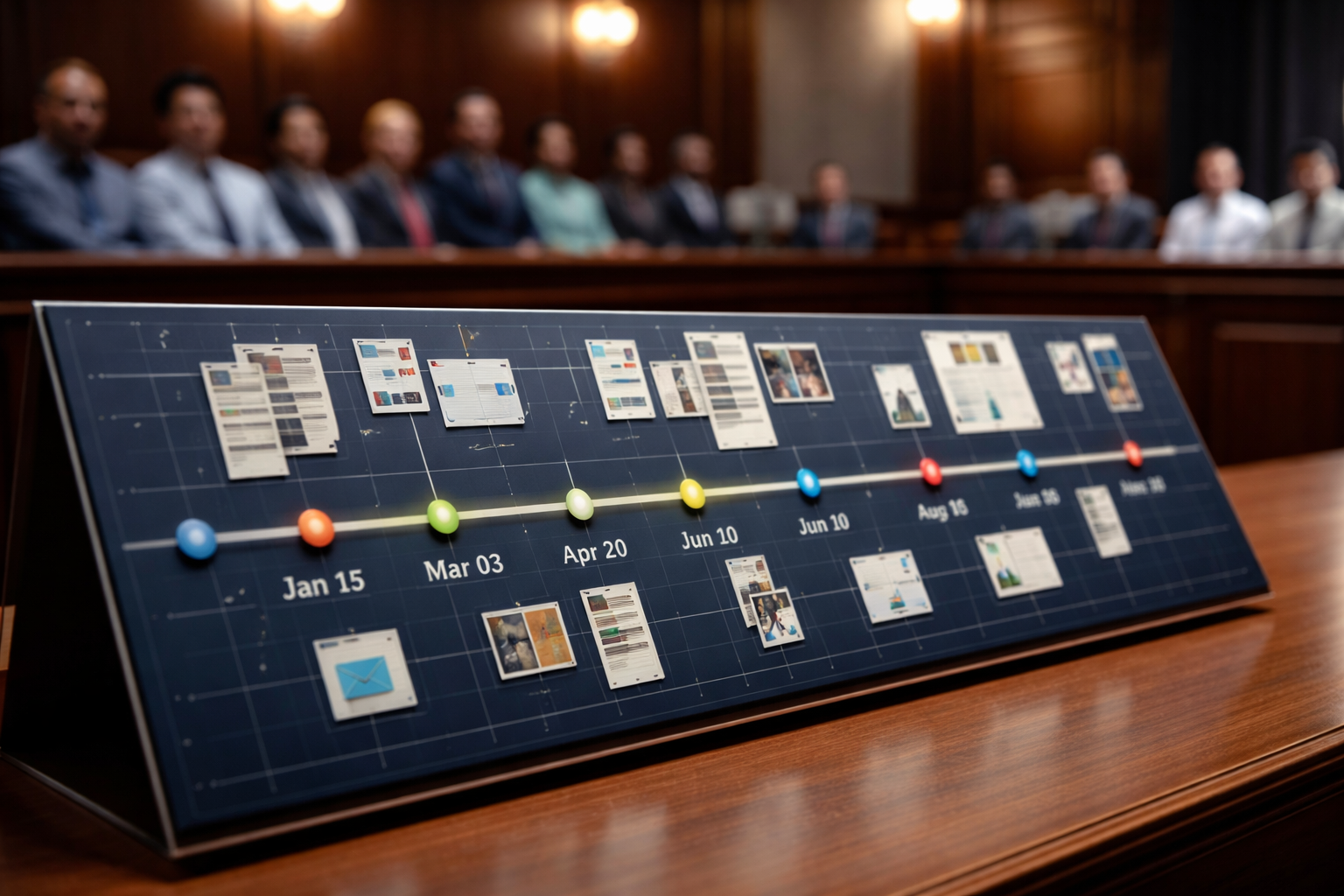
How to Track Witness Timelines and Catch Contradictions Fast

Catch witness contradictions fast with proven timeline tracking methods. Spot inconsistencies, strengthen your case, and win depositions.

Picture this: You’re three weeks into a complex litigation case, and your legal team has deposed a key witness. During the cross-examination at trial, you notice something doesn’t quite add up. The witness claims they witnessed an event at 2:15 PM, but their earlier deposition statement said it was closer to 3:00 PM. You flip through pages of documents, trying to verify which timeline is correct—but crucial minutes tick by as you search. By the time you’ve located the contradiction, the moment to challenge the witness has passed.

This scenario plays out far too often in courtrooms across the country. Witness testimony is frequently the linchpin of litigation cases, yet tracking witness statements across multiple depositions, interviews, and documents can quickly become a logistical nightmare. Learning how to track witness timelines and catch contradictions fast isn’t just a matter of good legal practice—it’s essential for building a compelling case and protecting your client’s interests.

In this comprehensive guide, we’ll explore proven strategies for managing witness information effectively, identifying inconsistencies before they become problems at trial, and leveraging modern technology to streamline the process. Whether you’re a solo practitioner handling your first complex case or an attorney managing a litigation team across multiple matters, these insights will help you organize witness evidence more efficiently and present a stronger case.

Why Witness Timeline Inconsistencies Matter More Than You Think

Before diving into the how-to, it’s important to understand why tracking witness timelines is so critical to litigation success. Witnesses are human beings, and human memory is notoriously unreliable. Furthermore, witnesses may have different motivations, biases, or interpretations of events that shape how they recall facts.

The Psychology of Witness Memory

Research in cognitive psychology has consistently demonstrated that eyewitness testimony, while often compelling to juries, is surprisingly fallible. Witnesses don’t maliciously lie in most cases—instead, their memories are shaped by factors such as:

  • Stress and emotional impact: Events that occur during high-stress situations are processed differently by the brain, often resulting in fragmented or distorted memories
  • Time passage: Witness accounts become less accurate as time elapses between the event and the testimony
  • Suggestibility: Leading questions or exposure to other people’s accounts can inadvertently alter a witness’s recollection
  • Confirmation bias: Witnesses tend to remember details that align with their pre-existing beliefs or expectations

Consequently, inconsistencies in witness timelines don’t necessarily indicate deception—they often reflect the natural limitations of human memory. However, from a litigation perspective, these inconsistencies can be exploited by opposing counsel or undermine your case’s credibility if left unexamined.

How Contradictions Impact Case Outcomes

When witness statements contradict each other—or when a single witness contradicts themselves—the consequences ripple throughout your case. Specifically, contradictions can:

  • Undermine credibility: Juries place tremendous weight on witness credibility. A witness caught in a contradiction, even an innocent one, loses persuasive power
  • Create reasonable doubt: In criminal cases, witness contradictions can provide the foundation for a reasonable doubt defense
  • Shift jury perception: Contradictions that favor opposing counsel can swing jury opinion and case outcomes
  • Complicate settlement negotiations: Uncertainties about witness testimony can make it harder to assess case value and reach favorable settlements
  • Require additional discovery: Unresolved contradictions often necessitate further depositions, interrogatories, or expert analysis, increasing litigation costs

For these reasons, identifying and addressing witness timeline contradictions early—ideally before trial or even before depositions are finalized—allows you to develop a strategy to explain the inconsistencies, strengthen your narrative, or adjust your case theory accordingly.

The Traditional Approach: Why Manual Tracking Falls Short

Many law firms still rely on traditional methods to manage witness information: maintaining separate witness interview notes, storing deposition transcripts in document management systems, and creating timelines in Word documents or spreadsheets. While these approaches have served the legal profession for decades, they suffer from significant limitations when dealing with complex cases involving multiple witnesses.

Common Challenges with Manual Witness Timeline Management

Fragmentation across systems: Witness information is often scattered across email, case management software, document repositories, and physical files. Attorneys must toggle between multiple systems to cross-reference details, creating inefficiency and increasing the likelihood of overlooking important information.

Time-consuming comparison: Manually comparing witness statements across interviews, depositions, and written statements requires substantial time investment. Additionally, attorneys must manually review each document, identify relevant passages, and note chronological details—a process that becomes exponentially more difficult as case complexity increases.

Difficulty visualizing relationships: In cases with numerous witnesses, understanding how different witness accounts relate to each other and to documented events becomes increasingly challenging. Moreover, it’s difficult to quickly identify which witnesses corroborate each other and which contradict the overall narrative.

Version control problems: When witness statements are stored in separate locations, it’s easy to lose track of which version is current. Furthermore, if multiple team members are working on the case, different attorneys might reference different versions of a statement, creating confusion and inconsistency.

Limited search and filtering capabilities: Spreadsheets and document repositories offer limited ability to quickly locate specific information. For instance, finding all references to a particular time, location, or event across multiple witness statements requires manual searching and reading.

Collaboration difficulties: When witness information is scattered across multiple systems and formats, it’s hard for legal teams to collaborate effectively. Consequently, different team members may reach different conclusions about witness credibility or consistency.

These limitations don’t just represent minor inefficiencies—they can result in missed contradictions, inadequate witness preparation, weaker case presentations, and ultimately, unfavorable case outcomes.

Building an Effective Witness Timeline System

Recognizing the limitations of traditional approaches, forward-thinking legal professionals have begun implementing more systematic methods for tracking and managing witness information. Indeed, developing a structured approach to witness timeline management can dramatically improve your case preparation and trial readiness.

Step 1: Centralize All Witness Information

The first essential step is establishing a centralized repository for all witness-related information. Rather than having witness details scattered across multiple documents and systems, consolidate everything in one place where it can be easily accessed, updated, and referenced.

What to include in your witness information hub:

  • Basic witness details (name, contact information, relationship to parties, areas of knowledge)
  • Interview notes and summaries
  • Deposition transcripts and video clips
  • Witness statements and affidavits
  • Prior inconsistent statements or writings
  • Credibility assessments and impeachment material
  • Timeline of events as described by the witness
  • Cross-references to documents that corroborate or contradict the witness’s account

By consolidating this information in one system, you ensure all team members are working from the same source of truth and can quickly access the information they need.

Step 2: Create Chronological Event Records

Next, you should develop a chronological timeline of events as described by each witness. Rather than leaving witness accounts embedded in narrative form within deposition transcripts, extract the specific events and times each witness describes.

For each event, document:

  • Date and time (or estimated time if exact time is unclear)
  • Location
  • Description of what occurred
  • Who was present
  • What the witness observed or heard
  • Any documents that reference this event
  • Cross-references to other witnesses who describe the same or related events

This approach transforms scattered narratives into structured, comparable data. Moreover, the chronological format makes it immediately obvious when witnesses disagree about timing, location, or what occurred.

Step 3: Implement a Standardized Notation System

Additionally, developing a standardized notation system helps identify different types of witness statements and inconsistencies. For example, you might use different indicators for:

  • Direct observation: Events the witness personally witnessed
  • Hearsay: Information the witness heard from others
  • Inference: Conclusions the witness drew from available information
  • Contradictions: Information that conflicts with other witness accounts
  • Corroboration: Information that aligns with other witness accounts
  • Prior inconsistency: Statements that contradict the witness’s other statements

This notation system allows team members to quickly understand the nature and reliability of each piece of information without re-reading lengthy documents.

Step 4: Compare and Analyze Witness Accounts

Once you’ve organized witness information chronologically, the real analytical work begins. Specifically, you should systematically compare witness accounts to identify:

Temporal contradictions: Do witnesses agree about when events occurred? Even small discrepancies in timing can be significant, particularly if they relate to causation or sequence.

Location discrepancies: Do witnesses agree about where events took place? Different locations could suggest different vantage points or suggest witnesses are describing different events.

Sequence inconsistencies: Do witnesses agree about the order in which events occurred? Sequence is often critical to causation and liability.

Participant discrepancies: Do witnesses agree about who was present at key events? Missing or unexpected participants can raise credibility questions.

Action contradictions: Do witnesses describe the same actions in similar ways, or do their descriptions vary significantly? Substantial variations might indicate faulty memory, bias, or deception.

Detail consistency: Do peripheral details (weather, clothing, mood) match across witness accounts? Consistency in incidental details suggests reliable observation, while major discrepancies raise questions about reliability.

Step 5: Document Your Findings

Finally, document your analysis in a comprehensive witness contradiction report. Rather than keeping these insights in your head or scattered across notes, create a written record that:

  • Identifies each contradiction or inconsistency
  • Cites the source (deposition page, interview date, etc.) for each conflicting account
  • Explains potential reasons for the discrepancy
  • Assesses the significance of the contradiction to your case
  • Recommends strategies for addressing the inconsistency

This documentation serves multiple purposes. First, it ensures that all team members understand the contradiction issues. Second, it creates a record that can inform witness preparation and deposition strategy. Third, it provides a foundation for trial exhibits and cross-examination questions.

Leveraging Technology: How Modern Tools Accelerate Witness Timeline Analysis

While a systematic manual approach improves upon traditional methods, technology can dramatically accelerate the process of tracking witness timelines and identifying contradictions. Modern legal timeline software has been specifically designed to address the challenges that attorneys face when managing complex witness information.

Why Specialized Legal Timeline Software Matters

General-purpose tools like spreadsheets, document management systems, and project management software can be pressed into service for witness timeline management, but they require significant workarounds and lack features specifically designed for legal analysis. Conversely, specialized legal timeline software is purpose-built to help attorneys organize, visualize, and compare chronological events.

Consider using cloud-based legal timeline software designed specifically for attorneys. These platforms offer several advantages over traditional document management or spreadsheet approaches:

Centralized accessibility: Cloud-based platforms allow all team members to access witness timelines from any location with internet connectivity. This is particularly valuable for legal teams working across multiple office locations or with remote workers. Furthermore, you don’t need to install software or maintain servers—everything is accessible through your web browser.

Integrated document management: Rather than jumping between a timeline document and a separate document repository, modern legal timeline software allows you to attach relevant documents, deposition excerpts, and exhibits directly to timeline events. Consequently, all relevant information for each event is accessible in one place.

Visual timeline presentation: Instead of reviewing chronological information in text or spreadsheet format, visual timeline tools present events in graphical formats that make patterns, gaps, and inconsistencies immediately apparent. This visual approach engages different parts of your brain and often reveals insights that textual analysis might miss.

Filtering and search capabilities: Modern timeline platforms offer sophisticated filtering and search functions that allow you to quickly locate specific events, time periods, witnesses, or themes without manually reviewing entire documents. For instance, you can instantly filter to show only events that occurred on a specific date or only events involving a particular witness.

Collaboration features: Multi-user platforms allow your entire legal team to view, edit, and contribute to witness timelines simultaneously. Furthermore, you can assign tasks, leave comments, and track changes—ensuring everyone stays coordinated.

Automated contradiction detection: Some advanced platforms can help identify potential contradictions by highlighting events with similar descriptions or timing that might warrant closer examination.

Implementing Technology Into Your Witness Timeline Process

If you decide to implement timeline software into your practice, here’s how to maximize its value:

Start with a pilot case: Rather than attempting to migrate all your cases to new software simultaneously, begin with a single complex case that would benefit most from improved timeline management. This allows you to learn the platform, develop best practices, and demonstrate value before broader implementation.

Establish data entry protocols: Develop clear guidelines for how witness events should be entered into the system. What information is essential? How should times be formatted? What level of detail is appropriate? Standardized protocols ensure consistency and data quality.

Integrate with your existing workflow: The software should complement rather than disrupt your existing case management processes. Make sure your team can seamlessly input deposition information, attach documents, and access the timeline from their usual tools.

Train your team thoroughly: Like any new tool, timeline software requires proper training. Invest time in teaching your team how to use the platform effectively, highlighting features relevant to your practice, and developing shortcuts to improve efficiency.

Use the visualization features: Don’t just use timeline software as a fancy database. Take advantage of graphical presentations to analyze patterns, identify gaps, and spot inconsistencies visually. Print timelines for trial exhibits, client presentations, and team meetings.

Practical Strategies for Catching Witness Contradictions Before Trial

Beyond implementing systems and technology, several practical strategies help you identify and address witness contradictions earlier in the litigation process.

Strategic Deposition Planning

Rather than taking depositions haphazardly, develop a deposition strategy that specifically targets timeline verification. Before each witness deposition, prepare detailed questions about:

  • Specific times: Rather than asking “when did this happen,” ask “what time did you arrive at the location?” and “how long did you stay?” and “what did you do next?” Building a detailed timeline during the deposition creates a record you can compare against other witnesses.
  • Corroborating details: Ask about incidental details that can be verified independently—weather conditions, what people were wearing, what music was playing, what events were happening elsewhere. These details help assess the reliability of the witness’s observation.
  • Prior statements: Ask the witness to confirm they gave prior statements and ask them to explain any differences between prior statements and current testimony. Lock the witness into their current position so you can later confront them with prior inconsistencies if necessary.
  • Other witnesses: Ask what other witnesses were present and what they observed. This helps you identify who else can corroborate or contradict the witness’s account.

Witness Summary Comparisons

After each deposition or interview, prepare a brief summary of the witness’s key timeline statements. Furthermore, compare this summary against summaries from other witnesses. Specifically, look for:

  • Events both witnesses describe
  • Timing discrepancies
  • Location disagreements
  • Different descriptions of the same event

Conducting this analysis immediately after each deposition, while the information is fresh, often reveals contradictions that might otherwise be missed when you’re reviewing the case months later.

Creating Demonstrative Exhibits

Consider creating visual timeline exhibits that show witness accounts side-by-side. These exhibits can be invaluable for:

  • Trial presentation: Jury-friendly timeline graphics that show what different witnesses claim happened and when
  • Witness impeachment: Side-by-side comparisons that clearly show contradictions, making it difficult for witnesses to explain away discrepancies
  • Settlement negotiations: Demonstrative exhibits that visually show the strength of your timeline narrative often facilitate more realistic settlement discussions
  • Team meetings: Visual presentations that help your entire team understand the case’s chronological complexity

Real-World Example: How Timeline Analysis Impacted Litigation Outcomes

Consider a hypothetical personal injury case where a plaintiff claims they were injured due to a defendant’s negligence. The defendant claims the plaintiff was partially responsible for the accident. The case hinges on the sequence of events immediately preceding the collision.

The witnesses provided conflicting accounts:

  • Plaintiff witness 1 stated: “The light turned green for us at 2:47 PM, and we entered the intersection immediately”
  • Defendant witness 1 stated: “I saw the other car run a red light. It was approximately 2:48 PM”
  • Plaintiff witness 2 stated: “We had been in the intersection for about 10 seconds when the defendant’s car came from nowhere”
  • Defendant witness 2 stated: “The defendant had already been through the intersection when the plaintiff’s car entered”

Without a systematic timeline approach, these statements might seem to be a confusing he-said-she-said situation. However, by organizing each statement chronologically and examining the temporal relationships, the legal team realized something crucial:

If the plaintiff entered the intersection at 2:47 PM and had been in the intersection for 10 seconds before the defendant’s car arrived, the defendant would have entered at approximately 2:47:10 PM. But the defendant’s witness stated the defendant had already cleared the intersection when the plaintiff entered. These statements are mutually exclusive.

This analysis revealed a critical credibility issue with the defendant’s witnesses. Furthermore, it allowed the plaintiff’s team to confidently assert the defendant’s account was factually impossible. This insight proved decisive during settlement negotiations, leading to a more favorable resolution for the plaintiff.

Lessons from the Example

This example illustrates several important points:

  • Specific timing matters: Vague references to time (“around 2:47”) matter less than precise sequences (“10 seconds after entering”)
  • Logical analysis reveals truth: Careful examination of temporal relationships can expose contradictions that aren’t obvious from reading statements in isolation
  • Documentation is essential: A written timeline allows you to validate your analysis and present it persuasively to opposing counsel, judges, and juries

The Power of Visualization in Witness Analysis

One often-overlooked advantage of modern timeline management is the power of visualization. Our brains process visual information differently than text, and visual presentations often reveal patterns and contradictions that text-based analysis might miss.

Why Visual Timelines Are More Effective

Pattern recognition: When events are displayed chronologically on a visual timeline, patterns become obvious. For instance, you might notice that certain witnesses consistently describe events as occurring later than other witnesses describe them, suggesting systematic bias.

Gap identification: Visual timelines make it immediately apparent when there are unexplained gaps in the timeline or events that lack corroborating witnesses.

Relationship understanding: Graphics make it easier to understand the relationships between events. For instance, you can see at a glance whether alleged causation makes logical sense temporally.

Jury persuasion: Juries respond more positively to visual presentations than text-heavy documents. A clear, well-organized timeline graphic is far more persuasive than asking jurors to wade through pages of testimony.

Efficient communication: A visual timeline communicates complex information in seconds that might take minutes or hours to explain verbally or in writing.

Addressing Witness Contradictions: Strategy and Approach

Once you’ve identified witness contradictions, the question becomes: how do you address them? The approach depends on the nature of the contradiction and your litigation strategy.

Evaluating Contradiction Significance

Not all contradictions are equally significant. Before investing substantial effort in addressing a contradiction, evaluate its importance:

Critical contradictions: These directly relate to liability, damages, or key elements of your case. Addressing critical contradictions should be a priority.

Peripheral contradictions: These relate to incidental details that don’t significantly impact the case outcome. While still important for credibility, they may warrant less aggressive pursuit.

Explainable contradictions: Sometimes contradictions result from honest confusion (like mistaking times), different vantage points, or legitimate differences in perception. These often can be explained without undermining the witness.

Credibility-damaging contradictions: Some contradictions so undermine a witness’s credibility that you may want to highlight them aggressively.

Strategies for Addressing Contradictions

Witness preparation: If a contradiction involves your own witness, address it during witness preparation. Develop an explanation for the discrepancy and prepare the witness for cross-examination questions. Often, witnesses can explain apparent contradictions in ways that actually strengthen their credibility.

Rebuttal witnesses: If a critical contradiction involves opposing witnesses, consider whether you can present rebuttal witnesses whose testimony resolves the discrepancy.

Documentary evidence: Look for documents (photos, videos, text messages, emails, timestamps) that definitively establish what actually occurred, thereby resolving witness contradictions.

Expert analysis: In some cases, expert witnesses (accident reconstructionists, medical professionals, etc.) can provide authoritative analysis that resolves timeline contradictions.

Deposition impeachment: If you intend to use a witness contradiction during trial, you’ll typically want the opposing witness to have been locked into their contradictory statement during deposition. This creates a record that’s difficult to explain away.

Streamlining Your Witness Timeline Process with TrialLine

While we’ve discussed systematic approaches and technology broadly, platforms like TrialLine specifically address the challenges attorneys face when managing complex witness timelines. TrialLine is a cloud-based legal timeline software designed specifically for attorneys, offering features that streamline the witness tracking and contradiction-identification process.

How TrialLine Solves Witness Timeline Challenges

TrialLine allows attorneys to:

Build comprehensive witness timelines: Rather than maintaining witness information across multiple systems, TrialLine provides a unified platform where you can organize all witness-related events chronologically, attach relevant documents, and note timeline discrepancies.

Visualize witness accounts: The platform’s timeline visualization capabilities help you see witness accounts in graphical format, making contradictions and patterns immediately apparent.

Collaborate with your team: Multiple attorneys can view, edit, and contribute to witness timelines simultaneously, ensuring your entire team works from the same accurate information.

Search and filter efficiently: Rather than manually reviewing deposition transcripts, you can quickly search for specific events, times, or themes across all witness accounts.

Prepare for trial effectively: TrialLine’s visualization capabilities help you create compelling demonstrative exhibits that clearly show witness contradictions and strengthen your case presentation.

By consolidating witness information into a single, organized, visual format, TrialLine reduces the time you spend on administrative case management and increases the time you spend on strategic case analysis.

Frequently Asked Questions About Witness Timeline Management

Q: How detailed should witness timeline entries be?

A: Include enough detail to understand the event and identify contradictions, but avoid unnecessary verbosity. Generally, a few sentences describing what happened, when it happened, where it happened, and who was present is sufficient. You can always reference the original deposition or interview for additional context.

Q: Should I track every statement a witness makes, or only major events?

A: Focus on events that are material to your case. While you don’t need to track every minor detail, be comprehensive about events that relate to causation, liability, damages, or key issues in dispute.

Q: How can I manage contradictions between witnesses who witnessed different events?

A: Not all contradictions are equivalent. If witnesses witnessed different events or had different vantage points, you wouldn’t necessarily expect their accounts to perfectly align. Document the different perspectives, but focus contradiction analysis on witnesses who should have witnessed the same events.

Q: What should I do if I discover a contradiction in my own client’s testimony?

A: Address it immediately during witness preparation. Help your client understand where the contradiction exists and develop an explanation. It’s far better to address this proactively during preparation than to be blindsided by opposing counsel during trial.

Q: Can witness timeline software help with criminal cases differently than civil cases?

A: The fundamentals are similar, but criminal cases often involve more witnesses and more complex timelines. Timeline software is equally valuable in criminal practice, perhaps even more so given the complexity of many criminal cases.

Conclusion: Building a Stronger Case Through Systematic Witness Timeline Management

Tracking witness timelines and catching contradictions fast is not simply a matter of good legal housekeeping—it’s a fundamental litigation skill that directly impacts case outcomes. By implementing systematic processes, leveraging appropriate technology, and developing a strategic approach to witness analysis, you can:

  • Identify contradictions early, when they’re easier to address and before they become trial problems
  • Build a stronger case narrative, by thoroughly understanding the sequence of events as described by all witnesses
  • Improve team collaboration, by ensuring all attorneys have access to organized, accurate witness information
  • Present your case more persuasively, through clear, visual demonstrations of credibility and contradiction
  • Reduce litigation costs, by preventing surprises at trial and facilitating more informed settlement discussions

The legal profession has historically relied on manual methods for managing witness information, and many attorneys continue using these approaches despite their limitations. However, the complexity of modern litigation increasingly demands more systematic, technology-enabled approaches.

Whether you implement a manual system with careful documentation protocols, leverage cloud-based legal timeline software, or combine both approaches, the key is establishing a structured process that ensures no witness contradiction is overlooked and no important temporal relationship is missed.

Next Steps to Improve Your Witness Timeline Management

Start today by identifying your most complex pending case and applying the principles outlined in this guide. Specifically:

  • Gather all witness statements and deposition transcripts
  • Extract key timeline events for each witness
  • Create a chronological comparison showing where witnesses agree and disagree
  • Document discrepancies and plan how you’ll address them

If your case involves numerous witnesses or complex temporal relationships, consider whether specialized timeline software like TrialLine might help you manage the information more efficiently and analyze patterns more effectively. Many attorneys find that the time savings and improved analysis capabilities quickly justify the investment in purpose-built legal timeline software.

Remember, the attorney who thoroughly understands their case’s timeline—including every contradiction, every point of agreement, and every temporal relationship—is invariably better prepared for trial, better positioned to negotiate settlements, and more likely to achieve favorable outcomes for clients.

Your witnesses’ stories matter tremendously. Make sure you’re capturing, organizing, and analyzing them in ways that maximize your case’s potential. By systematically tracking witness timelines and catching contradictions fast, you’re not just improving your case management—you’re building a stronger foundation for case success.

How Legal Teams Organize Depositions Into Winning Timelines

Master deposition organization to build airtight case timelines. Discover proven strategies legal teams use to eliminate confusion, impress judges, and win trials.

The conference room fell silent as opposing counsel presented their version of events. But there was a problem—the timeline they displayed didn’t align with the deposition transcript from six months ago. Your paralegal shuffled through three separate documents trying to find the exact date. Meanwhile, your client looked confused, the judge seemed skeptical, and valuable trial time ticked away.

This scenario plays out in law offices across the country every single day. Depositions generate mountains of information—testimony, contradictions, admissions, and crucial details that can make or break your case. Yet many legal teams struggle to organize this critical information into a coherent, compelling narrative. They rely on scattered notes, multiple spreadsheets, and document folders that make it nearly impossible to see the complete picture at a glance.

The solution? Transforming deposition data into a structured, visual timeline that tells your case story with clarity and impact. In this guide, we’ll explore how sophisticated legal teams organize depositions into winning timelines that strengthen case strategy, improve team collaboration, and ultimately lead to better client outcomes.

Why Deposition Organization Matters More Than Ever

Depositions represent one of the most information-intensive phases of litigation. A single deposition can generate dozens of pages of transcript, potentially revealing contradictions, establishing facts, and creating opportunities for case development. Yet the raw deposition transcript, by itself, tells only part of the story.

The challenge is this: depositions don’t exist in isolation. They’re part of a larger case narrative. Understanding the full impact of deposition testimony requires connecting it to other depositions, documents, evidence, and the timeline of underlying events. Without proper organization, even the most damaging admission buried in page 47 of a deposition transcript can slip through the cracks.

Moreover, modern litigation generates exponentially more information than it did a decade ago. Email, text messages, social media posts, and digital documents create an endless stream of potential evidence. Depositions help attorneys navigate this information overload by allowing them to ask targeted questions and lock in testimony. However, translating that testimony into actionable case intelligence requires deliberate organizational systems.

Furthermore, depositions serve multiple purposes throughout litigation. Early depositions help attorneys understand the facts and identify weaknesses in their own case. Later depositions are often strategic, designed to lock witnesses into specific positions or impeach credibility. Trial preparation depositions refresh attorney memory and prepare cross-examination strategies. Each deposition serves different purposes at different stages of the case lifecycle, and your organizational system needs to accommodate this complexity.

The Hidden Costs of Disorganized Deposition Management

Before diving into solutions, let’s examine what disorganized deposition management actually costs your law firm. The expenses go far beyond the obvious inefficiency of searching for information.

First, there’s the time cost. Attorneys and paralegals spend countless hours cross-referencing depositions with documents, emails, and other evidence. A task that should take minutes—finding when a witness claimed something happened—can stretch into hours when information is scattered across multiple systems. Multiply this across dozens of depositions and hundreds of case events, and you’re looking at weeks of lost productivity annually. This time directly impacts your firm’s profitability and your attorneys’ ability to focus on high-value strategic work.

Second, there’s the risk of missed connections. In complex litigation, patterns and inconsistencies often emerge only when information is viewed holistically. A witness’s statement in one deposition might contradict something they said in another, or an email might expose a lie told under oath. However, if deposition testimony remains siloed in separate transcripts, these critical contradictions remain hidden. Consequently, you might miss opportunities to strengthen your case or fail to catch lies that opposing counsel will use against you.

Third, there’s the communication barrier within your legal team. Different team members may interpret the same deposition differently. Without a unified source of truth about what was said and when, your team members might operate with different understandings of crucial facts. This can lead to miscommunication, duplicated efforts, and strategic inconsistencies in how you present your case.

Additionally, there’s the client management impact. Clients expect their attorneys to have complete command of case facts. When you can’t quickly answer a client question about what a specific witness said or when an event occurred, confidence erodes. Moreover, clients increasingly expect sophisticated case presentations that leverage technology and visual storytelling. If you’re still relying on pages of transcript printouts and handwritten notes, you’re not meeting modern client expectations.

Finally, there’s the trial preparation challenge. As trial approaches, you need to quickly access deposition testimony to prepare cross-examination questions, identify impeachment opportunities, and craft your narrative. Scrambling to find relevant testimony two weeks before trial isn’t just stressful—it’s a recipe for missed opportunities and suboptimal trial performance.

Building Your Deposition Timeline Framework

Creating an effective deposition timeline requires more than simply dumping deposition transcripts into a file folder. You need a deliberate framework that captures relevant information, connects it to other case events, and presents it in a format that supports decision-making and trial preparation.

Step 1: Identify Your Key Deposition Events

Not every piece of testimony deserves timeline status. Your first task is determining which deposition statements constitute events worthy of timeline placement. Consider including:

  • Factual admissions: Statements where a witness admits something crucial to your case narrative
  • Timeline anchors: Specific dates and times that establish when events occurred
  • Contradictions: Testimony that contradicts other evidence or prior statements
  • Credibility markers: Evasive answers, obvious lies, or statements that damage a witness’s credibility
  • Expert opinions: Key conclusions from expert witnesses that support your case
  • Business practices: Testimony about how an organization operated at relevant times
  • Notice or knowledge: Statements establishing what someone knew and when they knew it

This selective approach ensures your timeline remains focused and digestible rather than becoming an unwieldy document containing thousands of granular details.

Step 2: Extract Information With Precision

When you identify events worthy of timeline inclusion, extract them with precision. Include:

  • The specific quote from the deposition transcript
  • The page and line reference so you can quickly navigate to the original testimony
  • The date of the deposition to establish when the testimony occurred
  • The witness name and their role in the case
  • The witness’s credibility assessment (is this a friendly witness, hostile, neutral?)
  • Contextual information about why this testimony matters

For example, rather than noting “witness said client was angry,” you’d capture: “John Smith (defendant’s business partner) testified on March 15, 2025 (page 47, lines 8-12) that the client ‘was furious’ when he learned about the contract. Smith has admitted to bias in favor of opposing counsel but provided detailed testimony about the client’s reaction to the discovery.”

This level of detail might seem excessive when you’re in the thick of litigation, but it pays enormous dividends when you’re preparing for deposition follow-ups, trial preparation, or responding to opposing counsel’s arguments.

Step 3: Connect Deposition Events to the Case Timeline

Here’s where deposition organization truly becomes powerful: connecting testimony to underlying case events. A witness might testify on March 15, 2025, about something that happened on January 10, 2024. Your timeline framework needs to place that testimony in the context of what was actually happening on January 10.

This means building a master timeline that includes:

  • Actual events: Things that happened in the underlying case (contracts signed, injuries sustained, communications sent)
  • Deposition testimony: What witnesses said about those events
  • Documentary evidence: Emails, contracts, photos, or other records from the time of the events
  • Discovery deadlines and case milestones: When events like discovery completion, motion deadlines, or depositions occurred

When you can visualize how deposition testimony relates to actual case events and documentary evidence, patterns emerge. You might notice that a witness’s testimony contradicts contemporaneous emails, or that multiple witnesses independently confirmed the same sequence of events.

Advanced Organization Techniques for Complex Litigation

For litigation involving multiple parties, numerous events, or extended time periods, standard organizational approaches quickly become insufficient. Advanced techniques help you manage complexity without losing critical information.

Creating Witness-Specific Timelines

Beyond the master case timeline, consider building witness-specific timelines that track what each key witness claimed happened and when. This approach is particularly valuable for:

  • Comparative analysis: Reviewing what multiple witnesses claimed about the same events
  • Credibility assessment: Tracking whether a witness’s story remained consistent across multiple depositions
  • Cross-examination preparation: Having a centralized view of everything a particular witness claimed, making it easier to identify impeachment opportunities
  • Deposition follow-up strategy: Understanding what areas you need to explore in follow-up depositions

A witness-specific timeline might reveal that John Smith’s account of events in his first deposition contradicted what he said in his second deposition. Armed with this knowledge, you can prepare targeted follow-up questions that lock him into a specific position or expose his credibility problems.

Tracking Deposition Inconsistencies and Impeachment Opportunities

Beyond organizing what was said, sophisticated legal teams track where contradictions and impeachment opportunities exist. Create a separate index that documents:

  • Internal contradictions: Where a witness contradicted something they said earlier in their own deposition
  • Cross-deposition contradictions: Where one witness’s testimony contradicts another’s
  • Testimony-to-document contradictions: Where deposition testimony contradicts documentary evidence
  • Evolution of stories: How a witness’s account changed from their first deposition to subsequent ones

Documenting these contradictions in real time—rather than trying to reconstruct them three months later—ensures you don’t miss critical opportunities. Moreover, having a centralized contradictions index makes trial preparation dramatically more efficient.

Organizing Deposition Evidence Exhibits

Depositions typically include exhibits—documents that witnesses reference or that opposing counsel enters into the record. These exhibits are crucial case evidence, yet they’re often scattered across multiple deposition transcripts and exhibit binders.

An effective organizational approach involves:

  • Cataloging all deposition exhibits in a centralized location with clear reference to which deposition they came from
  • Connecting exhibits to timeline events so you can see the exhibit and the relevant deposition testimony together
  • Tracking inconsistencies between what an exhibit shows and what a witness claimed about it
  • Maintaining version control if exhibits evolved over time (earlier emails versus later ones, for example)

This systematic approach to deposition exhibits ensures you have complete access to the evidence that was actually discussed under oath.

Leveraging Technology to Transform Deposition Organization

Historically, attorneys organized depositions using highlighters, sticky notes, and carefully maintained spreadsheets. While some firms still rely on these analog methods, modern legal teams increasingly leverage technology to transform how they manage deposition information.

Cloud-based legal timeline software represents a significant advancement in deposition organization. Rather than managing information across multiple documents and spreadsheets, specialized legal timeline platforms enable you to build comprehensive, interactive case timelines that integrate deposition testimony with other case information.

The advantages of technology-enabled deposition organization include:

  • Searchability: Instantly locate testimony about specific topics across dozens of depositions
  • Accessibility: Access your deposition timeline from any internet-connected device, whether you’re at the office, in the courtroom, or meeting with clients
  • Collaboration: Multiple team members can work on the same timeline simultaneously, ensuring everyone has access to the same information
  • Visualization: See your case as a chronological narrative rather than disconnected documents
  • Documentation: Maintain audit trails showing how your timeline has evolved as new information emerged
  • Integration: Link deposition testimony directly to supporting documents, exhibits, and other evidence
  • Presentation capability: Export or display your timeline to clients, judges, or juries in professional, compelling formats

For complex litigation, these technological advantages translate directly into better case outcomes. You spend less time searching for information and more time analyzing it. Your team maintains consistency in case understanding. And when trial arrives, you’re prepared with comprehensive knowledge of your case and the ability to present it compellingly.

Practical Strategies for Implementing Deposition Timelines

Understanding why deposition timeline organization matters is one thing. Actually implementing an effective system is another. Here are practical strategies successful legal teams use:

Establish Clear Protocols and Responsibilities

Before building your first timeline, establish clear protocols for who will be responsible for extracting information from depositions, what information must be captured, and how frequently the timeline will be updated. Assign primary responsibility to someone—often a senior paralegal or litigation support specialist—while ensuring backup coverage so the process doesn’t stall if that person becomes unavailable.

Clear protocols might specify that depositions are processed within 48 hours of completion, with all key events extracted and timeline entries completed within one week. This ensures the information is fresh in everyone’s mind while preventing backlogs that can stretch for months.

Develop Consistent Terminology and Formatting

When multiple team members contribute to timeline organization, consistency matters. Establish style guides for how you’ll describe events, reference documents, and categorize information. For example, you might decide that all contract references follow the format “[EXHIBIT X – Contract Name, Date]” and all dates are formatted as “MMM DD, YYYY” (e.g., “Mar 15, 2025”).

Consistent formatting might seem like a minor detail, but it dramatically improves usability. When a paralegal searches for a contract reference, they’ll find all instances using the same format. When reviewing the timeline, consistent formatting makes it easier to scan quickly for relevant information.

Balance Comprehensiveness With Readability

The goal is capturing sufficient detail for trial preparation without creating such a dense timeline that it becomes unusable. A helpful approach is tiered information capture:

  • Tier 1: Core facts that everyone on the team needs to know immediately
  • Tier 2: Supporting details relevant to specific case issues
  • Tier 3: Complete reference information for trial preparation or follow-up

Your timeline display might show Tier 1 information prominently, with Tier 2 and Tier 3 details available through expandable sections or linked documents. This approach ensures the timeline remains accessible while preserving detailed information for those who need it.

Update Your Timeline Throughout Litigation

Depositions don’t exist in a vacuum—they’re part of an ongoing litigation process. As new depositions occur, documents are produced, and witness interviews happen, your timeline must evolve. Schedule regular updates (perhaps monthly, or at key litigation milestones) where you review new information and integrate it into your timeline.

Additionally, as you learn new information, don’t hesitate to recontextualize previous entries. If a later deposition reveals that an earlier witness was mistaken about a date, update your timeline to reflect this new understanding. This dynamic approach ensures your timeline represents your current understanding of case facts.

Creating Compelling Narrative Timelines for Trial Preparation

As trial approaches, your internal organizational timelines—however detailed and useful—need to be translated into compelling narrative timelines that tell your case story to judges, juries, or mediators. This requires a different approach than your internal working timeline.

Narrative trial timelines should:

  • Follow a clear chronological sequence that builds your case narrative logically
  • Highlight deposition testimony that supports your case while acknowledging contradictions honestly
  • Include visual elements that make the timeline easier to understand and more memorable
  • Show context so decision-makers understand not just what happened, but why it matters
  • Avoid overwhelming detail while maintaining accuracy and supporting every statement with evidence

For example, rather than listing every detail from a deposition, your trial narrative might read: “On January 10, 2024, [Witness Name] testified that [key fact]. This testimony is supported by [documentary evidence], and corroborated by [other witness] who testified that [complementary fact].”

This narrative approach bridges the gap between your detailed internal timeline and the compelling storytelling needed to persuade judges or juries. It demonstrates that your case isn’t a collection of scattered facts—it’s a coherent narrative supported by testimony and evidence.

Frequently Asked Questions About Deposition Timeline Organization

Q: When should I start building my deposition timeline—early in the case or closer to trial?

A: Start as soon as you begin taking depositions. Early timeline building serves several purposes: it helps you identify gaps in your fact development, supports deposition follow-up strategy, and prevents the massive backlog that occurs if you defer timeline building until trial preparation. The timeline evolves throughout litigation, but starting early maximizes its value.

Q: How detailed should deposition timeline entries be?

A: Balance is key. Include enough detail that a team member can understand the relevance and importance of a particular piece of testimony without rereading the entire deposition transcript. But avoid such exhaustive detail that the timeline becomes unwieldy. A good rule of thumb: if a timeline entry would be better understood by simply reading the original deposition, it’s probably too brief. If it includes information that no one will ever use, it’s too detailed.

Q: What’s the best way to handle deposition testimony that contradicts other evidence?

A: Document contradictions clearly, including references to both the testimony and the contradicting evidence. Rather than hiding or minimizing contradictions, effective litigation teams acknowledge them and prepare to address them. Your timeline should clearly establish the contradiction so your team can discuss strategic approaches to handling it.

Q: Should I include testimony from opposing witnesses in my deposition timeline?

A: Absolutely. Your timeline should include testimony from all parties and key witnesses, both those favorable and unfavorable to your case. Understanding how opposing counsel’s witnesses testified helps you prepare responses and identify weaknesses in their case narrative. Moreover, you’ll likely need to reference opposing witness testimony during trial or settlement discussions, and having it organized in your timeline makes this much easier.

Transforming Organization Into Competitive Advantage

Legal teams that master deposition timeline organization gain significant competitive advantages. They understand their cases more deeply, make better strategic decisions, and present their cases more effectively. Conversely, teams that rely on scattered documents and incomplete organization waste time, miss opportunities, and risk trial performance that doesn’t reflect the actual strength of their case.

The good news? The organizational principles we’ve discussed are universally applicable. You can implement them whether you’re using a spreadsheet, a word processor, or specialized legal timeline software. What matters most is commitment to systematic, consistent organization throughout your litigation.

That said, digital solutions specifically designed for legal deposition organization offer significant advantages. Platforms like TrialLine provide cloud-based access to your timelines from any device, enable seamless team collaboration, allow rapid searching across complex cases, and support professional presentation of your case narrative. Rather than spending hours manually organizing depositions across multiple documents, you can leverage technology to automate these processes and focus your valuable time on case strategy and analysis.

Whether you implement deposition timeline organization through basic tools or sophisticated legal software, the outcome remains the same: your team has comprehensive understanding of your case, operates from unified information sources, and can effectively communicate your case narrative to clients, judges, and juries.

Taking Action: Your Next Steps

Ready to transform how your legal team organizes depositions? Start by assessing your current deposition management process. Where are deposition transcripts and testimony currently stored? How do team members search for information? What inconsistencies or gaps exist in your current organization?

Next, identify one case—preferably a moderately complex current matter—where you’ll implement improved deposition timeline organization. Use this case as your pilot project to test organizational approaches and build team expertise.

Finally, if you’re managing multiple complex cases or handling complex litigation regularly, evaluate whether specialized legal timeline software could streamline your deposition organization. The time saved by leveraging technology for deposition management quickly adds up across multiple cases and team members.

Your depositions contain the intelligence your case needs to succeed. By organizing deposition testimony into comprehensive, accessible, and compelling timelines, you transform raw transcripts into a strategic asset that strengthens every aspect of your litigation—from case development through trial presentation.

The question isn’t whether you can afford to invest in better deposition organization. The real question is whether you can afford not to.

Case Timeline Software: Stop Losing Trials to Disorganized Evidence

Master case timeline software to organize evidence flawlessly and win more trials. Stop losing cases to disorganization—discover proven strategies today.

Every trial attorney has experienced that sinking feeling during a deposition or court proceeding—a critical piece of evidence that should have been front-and-center is buried somewhere in a 500-page discovery file. Meanwhile, opposing counsel is presenting their case with surgical precision, their facts laid out in perfect chronological order. The difference between winning and losing often comes down to one simple thing: organization.

In today’s fast-paced legal environment, case timeline software has become less of a luxury and more of a necessity. The attorney who can quickly access and present a clear, chronological narrative of events has a significant advantage. Yet many law firms are still managing case timelines using spreadsheets, Word documents, and email threads—methods that are not only inefficient but also prone to critical errors. If you’re struggling to keep your cases organized or finding it difficult to present a compelling narrative to judges and juries, you’re not alone. The good news? There’s a better way.

The Hidden Cost of Disorganized Case Evidence

Before we discuss solutions, let’s talk about the problem. Case management in litigation is fundamentally complex. Consider a typical personal injury case: there might be incident reports, medical records, insurance communications, witness statements, discovery documents, deposition transcripts, and expert reports. For larger commercial litigation cases, this volume can multiply exponentially.

The time burden is staggering. According to industry research, attorneys spend an average of 20-30% of their time on administrative case management tasks rather than actual legal work. When evidence isn’t organized chronologically, attorneys waste countless hours:

  • Searching for specific documents across multiple folders and systems
  • Re-reading documents to establish the sequence of events
  • Recreating timelines manually for different case presentations
  • Reconciling discrepancies when team members have different versions of case facts
  • Explaining the case narrative repeatedly to team members who aren’t up to speed

Moreover, disorganized evidence creates legal risks. Missing a critical document in discovery because it was buried in an unstructured file system can have devastating consequences. Presenting an incomplete or unclear timeline to a judge or jury can undermine your case credibility and weaken your narrative—even when the underlying facts are in your favor.

Furthermore, when case information is scattered across multiple platforms, team members inevitably have different understandings of case facts and chronology. This inconsistency can manifest during trial preparation, client meetings, or even in court, creating confusion and reducing team effectiveness.

Why Traditional Organization Methods Fail Modern Litigation

Many law firms continue relying on outdated methods for organizing case timelines. Let’s examine why these approaches consistently fall short in contemporary legal practice.

Spreadsheets and Databases

At first glance, Excel or Google Sheets seem like reasonable solutions. They’re familiar, accessible, and cost-effective. However, spreadsheets have significant limitations:

  • Limited visualization: Numbers and text in rows and columns don’t tell a compelling story. A jury needs to see events unfold visually, not read through a data table.
  • Collaboration challenges: When multiple team members edit the same spreadsheet, version control becomes problematic. Who has the latest version? Which changes should be applied?
  • No document integration: Spreadsheets can’t efficiently link to supporting documents, evidence, or exhibits. You’re constantly switching between files.
  • Difficult searching: Finding specific information in a large spreadsheet becomes increasingly difficult as cases grow in complexity.

Word Documents and PDF Timelines

Some attorneys manually create timelines in Word documents or PDFs. While this approach allows for some narrative structure, it’s equally problematic:

  • Static and inflexible: Once created, timelines are difficult to update. Adding new information means reformatting the entire document.
  • Not collaborative: Multiple attorneys working on the same timeline leads to conflicting versions and lost work.
  • Impossible to synchronize: When discovery documents arrive, integrating them into a static timeline is tedious and time-consuming.
  • Poor for presentation: A PDF timeline doesn’t adapt to different presentation contexts—courtroom, client meeting, jury presentation.

Email and Chat Systems

Relying on email threads or messaging apps to track case information is perhaps the worst approach, yet many attorneys still do this. The problems include:

  • Information scattered across conversations: Critical details are buried in email chains that are difficult to search.
  • No unified view: Different team members have different email histories; no single source of truth exists.
  • Impossible to audit: When questions arise about what happened and when, reconstructing the sequence from email is a nightmare.
  • Security concerns: Sensitive case information in email systems creates data protection risks.

In contrast, purposeful case timeline software is specifically designed to address these shortcomings. Rather than adapting general-purpose tools to legal work, dedicated timeline software understands the unique needs of litigation.

The Power of Visual Case Organization

One of the most significant advantages of modern case timeline software is the ability to visualize events graphically. This capability goes far beyond what spreadsheets or documents can offer.

Why Visual Timelines Matter in Litigation

The human brain processes visual information 60,000 times faster than text. When you present a case timeline visually—showing events on a chronological axis, color-coded by category, with supporting documents attached—you create immediate clarity. Judges and juries can see at a glance:

  • The sequence of events and their relationships
  • Patterns and gaps in the narrative
  • Critical turning points in the case
  • The logical flow of cause and effect

For instance, in a personal injury case, a visual timeline might show the incident, immediate medical treatment, insurance claim, discovery of additional injuries, and subsequent medical procedures. When these events are presented in a clear visual format, the causal relationship between the incident and damages becomes obvious—far more effectively than reading through pages of text.

Interactive Elements That Enhance Understanding

Modern case timeline software goes beyond static graphics. Many platforms offer interactive features that allow:

  • Filtering by category: Show only medical events, only communications, only expert opinions, etc.
  • Zooming and navigation: Focus on specific time periods or expand to see the entire case history
  • Document linking: Click on any timeline event to view associated evidence immediately
  • Annotation capabilities: Add notes, highlighting, or commentary directly to the timeline
  • Multiple viewing modes: Display the same timeline in different formats for different audiences

These interactive elements mean you can create one master timeline and then customize presentations for different purposes—trial preparation, client meetings, deposition preparation, or jury presentation—without creating duplicate work.

How Cloud-Based Timelines Transform Legal Collaboration

Additionally, the shift from desktop-based or paper-based case management to cloud-based systems represents a fundamental improvement in how legal teams work together.

Accessibility Across Locations and Devices

Modern legal practice increasingly involves remote work, multi-office firms, and attorneys working from courthouses, client offices, and home. A cloud-based case timeline software ensures that any attorney on the team can access the most current case information from any internet-connected device—laptop, tablet, or smartphone.

Specifically, this means:

  • A junior associate can access the timeline from the law library while conducting research
  • A partner can review case facts from their home office in the evening
  • An attorney can present timeline information from a deposition or court appearance without printing documents
  • Traveling attorneys maintain access to case information regardless of location

This accessibility is particularly valuable for small and solo practitioners who might work across multiple locations or for firms with multiple offices. Rather than coordinating files across locations, everyone accesses the same cloud-based system.

Real-Time Collaboration and Version Control

Furthermore, cloud-based timelines eliminate version control nightmares. When multiple team members need to contribute to a case timeline—adding discovered documents, updating facts, incorporating expert opinions—cloud systems ensure everyone works on a single, current version.

The benefits include:

  • Simultaneous editing: Multiple attorneys can work on the same timeline without creating conflicting versions
  • Change tracking: The system records who made changes and when, creating an audit trail
  • Automatic synchronization: Updates are immediately visible to all team members
  • No manual consolidation: Unlike email-based workflows, there’s no need to merge different versions or reconcile conflicting edits

Improved Team Communication

Clearly, a centralized timeline improves team communication by establishing a single source of truth. Rather than having team members work from different understandings of case facts and chronology, everyone references the same organized timeline. This consistency is particularly important in complex litigation where multiple team members handle different aspects of the case.

Key Features to Look for in Case Timeline Software

Not all case timeline software is created equal. When evaluating options, look for these essential features:

1. Intuitive Timeline Creation

The software should make it easy to create timelines without requiring extensive training. Look for:

  • Drag-and-drop functionality for adding events
  • Customizable event categories and tags
  • Quick-search capabilities for finding existing events
  • Template options for common case types

2. Document Integration

Notably, the ability to attach and link documents to timeline events is critical. The software should:

  • Allow multiple documents per event
  • Support various file types (PDFs, images, Word documents, etc.)
  • Enable quick navigation from timeline events to supporting documents
  • Maintain document organization within the timeline structure

3. Collaboration Tools

For law firms and legal teams, collaboration features are essential:

  • Permission controls that allow you to manage who can view or edit timelines
  • Comment and annotation features for team discussion
  • Real-time collaboration for simultaneous editing
  • Notification systems that alert team members to changes

4. Customization and Visualization Options

Every case is different, so flexibility matters:

  • Multiple timeline view options (chronological, categorical, grouped)
  • Color-coding and visual filtering
  • Custom event types relevant to your practice area
  • The ability to export or present timelines in various formats

5. Security and Backup

Indeed, protecting sensitive case information is paramount:

  • Encryption for data in transit and at rest
  • Automatic backups and disaster recovery
  • HIPAA or other compliance certifications if applicable
  • Audit trails showing all access and modifications

6. Mobile Accessibility

Modern legal practice demands mobile access:

  • Responsive design that works on tablets and phones
  • Offline access for areas with poor connectivity
  • Mobile-optimized presentation features for courtroom use

TrialLine: Purpose-Built Timeline Software for Attorneys

While many general project management tools and document management systems can technically be adapted for timeline creation, TrialLine stands apart as the only cloud-based legal timeline software specifically designed for attorneys and legal professionals.

TrialLine addresses the specific pain points of legal practice by combining intuitive timeline creation with powerful case organization features. Rather than forcing attorneys to adapt general-purpose software to legal workflows, TrialLine is purpose-built with the legal professional’s needs in mind.

How TrialLine Solves Timeline Challenges

Specifically, TrialLine streamlines the case timeline process through:

  • Cloud-based accessibility: Access your case timelines from anywhere, on any internet-connected device—courtroom, client office, home, or while traveling
  • Document integration: Attach relevant documents, evidence, and exhibits directly to timeline events, keeping everything organized in one place
  • Real-time collaboration: Multiple team members can view, edit, and contribute to case timelines simultaneously, ensuring everyone has access to the same information
  • Visual presentation capabilities: Present case events in an easy-to-understand graphical format that makes it simpler to identify patterns, gaps, and inconsistencies in case facts
  • Filtering and search functionality: Quickly locate specific events or documents within complex timelines without manual searching

The result is significantly reduced administrative burden, allowing attorneys to spend less time managing documents and more time developing case strategy and serving clients effectively.

Practical Steps to Implement Case Timeline Software

If you’ve decided that case timeline software could benefit your practice, here’s how to approach implementation:

Step 1: Assess Your Current Workflow

First, examine how you currently manage case timelines. Specifically, consider:

  • What tools and systems do you currently use?
  • How much time do you spend on timeline-related administrative tasks?
  • What problems frustrate your team most?
  • How many attorneys and staff need access to case timelines?

Step 2: Define Your Requirements

Next, identify the specific features and capabilities your firm needs. Determine:

  • Must-have features versus nice-to-have features
  • Your budget constraints
  • Scalability needs—will you need the system to grow with your firm?
  • Integration requirements with existing systems (case management software, document repositories, etc.)

Step 3: Evaluate Available Solutions

Research options that align with your requirements. Additionally, seek out:

  • Free trials or demonstrations so you can test the software yourself
  • References from other law firms using the system
  • Reviews and comparisons on legal technology platforms
  • Information about customer support and training resources

Step 4: Plan Your Implementation

Subsequently, develop an implementation plan that includes:

  • Training for attorneys and staff
  • Timeline for rollout across cases and team members
  • Migration of existing case data if applicable
  • Designation of a point person for troubleshooting and questions

Step 5: Start Small and Scale

Rather than implementing across all cases at once, consider starting with a few pilot cases. This approach allows your team to:

  • Learn the software in a low-pressure environment
  • Identify workflow improvements before full rollout
  • Build confidence with the system before handling complex cases
  • Document best practices for your firm

Common Questions About Case Timeline Software

Is Case Timeline Software Worth the Investment?

Certainly, the ROI of case timeline software becomes clear when you calculate time savings. If an attorney spends even two hours per week on timeline-related tasks across multiple cases, that’s over 100 hours annually. Even at a modest billing rate, the value of recovered time quickly exceeds software costs.

Can Timeline Software Integrate with Existing Case Management Systems?

Many modern platforms, including TrialLine, offer integration capabilities or can work alongside existing systems. You can maintain your current case management structure while adding specialized timeline functionality where it’s most needed.

Is Cloud-Based Storage Secure Enough for Confidential Case Information?

Cloud-based legal software providers implement enterprise-grade security measures, including encryption, access controls, and compliance certifications. For most law firms, cloud-based systems are actually more secure than local storage, which is vulnerable to hardware failure, theft, or accidental deletion.

How Long Does It Take to Create a Case Timeline?

The time required depends on the complexity of your case and how well-organized your documents are. However, attorneys consistently report that creating a timeline in purpose-built software is significantly faster than building one manually. Once created, the timeline becomes a living document that’s easy to update as new information emerges.

Can Multiple Attorneys Work on the Same Timeline?

Yes, and this is one of the primary advantages of cloud-based timeline software. Real-time collaboration ensures all team members work from the same information and can see updates immediately.

Maximizing the Benefits of Case Timeline Software

Once you’ve implemented timeline software, here are strategies to maximize its effectiveness:

Establish Consistent Timeline Protocols

Create firm-wide guidelines for timeline creation and management. In particular, standardize:

  • Event naming conventions
  • Category and tag usage
  • Document attachment procedures
  • Frequency of timeline updates

Use Timelines Throughout Case Development

Rather than creating timelines only for trial, use them from case intake onward. Timelines can inform:

  • Initial case assessment and strategy development
  • Deposition question development
  • Discovery requests and responses
  • Settlement negotiations
  • Trial preparation

Incorporate Client and Witness Input

Moreover, timelines can be powerful tools for gathering information from clients and witnesses. Share timelines (with appropriate confidentiality protections) to:

  • Verify factual accuracy
  • Identify gaps or inconsistencies in your understanding
  • Refresh witness memories before depositions
  • Help clients understand their case narrative

Leverage Visual Presentations

Use timeline software’s visualization capabilities in multiple contexts:

  • Client meetings to explain case progression
  • Deposition preparation to establish clear questioning sequences
  • Discovery disputes when chronology is contested
  • Trial presentations to establish facts for judges and juries

The Future of Legal Case Management

The legal industry continues evolving toward integrated, technology-enabled practice management. Case timeline software represents a significant step in this evolution—not just another tool, but a fundamental shift in how attorneys organize and present case information.

In conclusion, the attorneys and firms that adopt modern case timeline software will have a competitive advantage. They’ll spend less time on administrative tasks and more time on strategic thinking. They’ll present clearer, more compelling narratives to judges and juries. Their teams will work more efficiently with better information. And ultimately, their clients will receive better service.

Your Next Steps: Getting Started with Better Case Organization

If you’re tired of losing valuable time to disorganized evidence and scattered case information, it’s time to explore case timeline software. To sum up, modern timeline software offers:

  • Centralized organization of case facts and documents
  • Visual presentation capabilities that enhance understanding
  • Cloud-based accessibility for modern legal practice
  • Collaboration tools that improve team efficiency
  • Significant time savings on administrative tasks

The question isn’t whether you can afford timeline software—it’s whether you can afford to continue managing cases without it.

Ready to transform how you organize and present case information? Explore TrialLine today. TrialLine’s purpose-built platform for attorneys makes it easy to create, manage, and present case timelines that win cases. With intuitive timeline creation, powerful document integration, real-time collaboration, and cloud-based accessibility, TrialLine helps legal professionals focus on what matters most: winning cases and serving clients effectively.

Start your journey toward better case organization. Visit TrialLine today and discover how purpose-built legal timeline software can transform your practice.

Why Judges Dismiss Cases: Timeline Gaps That Cost You Trials

Discover why judges dismiss cases due to timeline gaps—and how to prevent costly trial losses. Learn the critical evidence mistakes lawyers make.

You’ve invested months preparing your case. The research is thorough, the evidence is compelling, and your legal strategy is sound. Yet when you step into the courtroom, the judge dismisses your case—sometimes before you even get to present your strongest arguments. What went wrong?

The answer often lies in something seemingly simple: a gap in your case timeline. Judges don’t dismiss cases on a whim. They dismiss them because evidence doesn’t connect, events lack clear causation, or critical facts appear inconsistent or unexplained. When your case presentation contains timeline gaps—missing dates, unclear sequences of events, or disconnected pieces of evidence—judges see reasonable doubt and inconsistency. They see a case that hasn’t been fully developed or understood by the attorney presenting it.

In this comprehensive guide, we’ll explore why timeline gaps are one of the most underestimated reasons cases get dismissed, how these gaps develop in legal practice, and most importantly, how you can prevent them from derailing your trials.

The Hidden Cost of Timeline Gaps in Litigation

Understanding Why Judges Care About Sequence and Timing

Judges make decisions based on facts, law, and evidence presented in a logical sequence. Indeed, the ability to demonstrate how events unfolded chronologically is fundamental to legal reasoning. When you present a disorganized case—one where events jump around, dates are unclear, or the sequence of cause and effect isn’t obvious—you make the judge’s job harder. And judges don’t appreciate having to piece together a narrative that you should have already organized for them.

Furthermore, judges are trained to identify inconsistencies. They notice when event A supposedly caused event B, but the timeline shows event B occurring before event A. They spot when critical time periods are unexplained or when documentation suddenly jumps from one date to another with no explanation for what happened in between. These gaps don’t just look unprofessional—they actively undermine your credibility and weaken your case’s persuasiveness.

Consider a personal injury case. A plaintiff claims they sustained serious injuries on March 15, 2024. However, your case materials show they didn’t seek medical treatment until April 3, 2024—nineteen days later. That gap needs explanation. If you can’t clearly articulate why this gap exists and support that explanation with evidence, opposing counsel will exploit it, and the judge will question the severity of the injuries. In fact, courts have consistently ruled that unexplained delays in seeking medical treatment can reduce damages or even result in case dismissal.

The Statistics Behind Dismissals

The National Center for State Courts reports that a significant percentage of civil cases are disposed of through summary judgment or dismissal before trial. While many factors contribute to this outcome, disorganized case presentation—particularly poor timeline documentation—ranks consistently high among reasons cited in appellate decisions discussing case dismissals.

Moreover, legal professionals acknowledge that administrative inefficiency in case management directly correlates with case outcomes. Attorneys who don’t properly organize their case facts are more likely to miss critical deadlines, overlook contradictions in their own evidence, and fail to prepare persuasive narratives. Subsequently, these organizational failures manifest in weak trial presentations that judges dismiss or juries reject.

How Timeline Gaps Develop in Modern Legal Practice

The Challenge of Managing Complex Cases Across Multiple Formats

Most attorneys still manage case information using a combination of tools that were never designed to work together: email threads, document management systems, spreadsheets, physical files, and handwritten notes. Each of these formats stores information differently, making it remarkably easy to lose track of when events occurred or how they connect.

For example, consider a complex commercial litigation case involving thirty parties, spanning five years, with thousands of documents. One critical email exchange might be stored in your email system. A contract related to that exchange lives in your document management software. The resulting lawsuit filing is in your case management system. A deposition transcript discussing the email and contract sits in a separate digital repository. When you try to piece together the timeline, you’re forced to manually cross-reference information across four different systems. Additionally, you must manually record dates, search through hundreds of documents to find specific references, and physically organize this information in a way that tells a coherent story.

This fragmented approach almost guarantees timeline gaps. Important documents get overlooked. Dates are transcribed incorrectly. Relationships between events aren’t identified because the events exist in different systems and never get examined side by side. Subsequently, you walk into court with an incomplete understanding of your own case.

The Time Pressure Problem

In addition to format fragmentation, attorneys face constant time pressure. The average attorney at a mid-size firm handles multiple cases simultaneously. Partners must bill hours, manage client relationships, and handle administrative responsibilities. Associates work under tight deadlines to research and prepare case materials. In this environment, taking time to manually create a comprehensive, organized timeline feels like a luxury that most practices can’t afford.

Consequently, attorneys often proceed to trial without having fully organized their case timeline. They know the major facts, they understand the legal issues, but they don’t have a clear, visual representation of how events unfolded chronologically. Then, when opposing counsel presents a different timeline interpretation or when the judge asks a question about the sequence of events, the attorney discovers gaps or inconsistencies in real time. By then, it’s too late.

The Document Proliferation Challenge

Modern litigation generates enormous quantities of documents. Discovery produces thousands of pages of emails, contracts, memos, invoices, and other records. Each document potentially contains date information relevant to your case timeline. Nevertheless, many of these documents might seem tangentially related or their significance might not be immediately obvious.

The challenge intensifies in complex cases. An employment discrimination case might involve performance reviews, emails, text messages, witness statements, and HR records spanning several years. A product liability case could include design documents, manufacturing records, customer complaints, internal communications, and test results from various time periods. Successfully organizing this volume of material into a coherent timeline requires systematic approach—precisely the kind of systematic organization that manual processes make difficult.

Real-World Consequences: When Timeline Gaps Cost Attorneys Their Cases

Case Study: The Unexplained Delay That Cost Hundreds of Thousands

Consider a contract dispute case where a company claimed their vendor breached a service agreement. The attorney carefully documented all instances where the vendor failed to meet contractual obligations. However, during depositions, the other side discovered an eighteen-month period where the client never complained to the vendor about performance issues, never withheld payment, and never mentioned any problems. The client continued paying invoices and renewing the contract.

When confronted with this timeline gap, the plaintiff’s attorney couldn’t explain it. No communication documented the client’s dissatisfaction during that period. No records showed when the client first identified problems. The judge viewed the unexplained period as evidence that the client didn’t actually suffer damages during that time or that the client didn’t consider the vendor’s performance sufficiently problematic to warrant immediate action. Consequently, the damages award was significantly reduced, and the case was largely dismissed based on this timeline inconsistency.

Had the attorney created a comprehensive timeline upfront, they would have discovered this gap during case preparation rather than at trial. They could have documented their client’s activities during that period, located relevant evidence explaining the gap, or adjusted their legal strategy accordingly.

Case Study: The Missing Connection That Proved Fatal

In another instance, a personal injury attorney prepared a negligence case where the defendant’s careless action allegedly caused the plaintiff’s injury. The attorney documented the negligent act and the resulting injury, but failed to thoroughly document the causal sequence—what happened between the negligent act and when the injury manifested.

Subsequently, the defendant’s counsel presented medical evidence suggesting the injury occurred from a different cause. Without a clear, chronological timeline showing exactly when symptoms appeared, when the plaintiff sought treatment, what tests revealed, and how medical professionals linked the injury to the defendant’s negligence, the judge couldn’t clearly see the causal connection. The case was dismissed for failure to prove causation.

Critical Timeline Elements Judges Actually Examine

The Sequence of Events

First and foremost, judges examine whether events are presented in clear chronological order. This seems obvious, yet many case presentations jump around temporally. You might discuss Event C, then go back to Event A, then forward to Event B. This non-linear presentation makes it harder for the judge to follow your narrative and easier to miss inconsistencies.

Furthermore, judges specifically look for whether you can explain why Event A led to Event B. Causation matters tremendously in litigation. Did Event A happen before Event B with sufficient proximity in time to plausibly cause it? Or does the timeline suggest Event B had another cause? A clear timeline makes these causal relationships obvious.

Documentation and Evidence Placement

Judges want to see that every assertion you make is supported by documentation. Specifically, they examine whether you can point to documents—emails, contracts, medical records, photographs, witness statements—that support each event in your timeline. Additionally, they want to know when these documents were created, who created them, and whether they’re authentic.

Timeline gaps often reflect missing documentation. You can identify an event, but you have no document that proves when it occurred or what exactly happened. This creates reasonable doubt in the judge’s mind. Conversely, when your timeline is supported by clear documentation at every key point, judges find your case far more persuasive.

Consistency and Coherence

Judges are exceptionally good at identifying inconsistencies. They notice contradictions between your timeline and the evidence. They catch situations where your narrative doesn’t match the documentary record. Notably, any unexplained inconsistency reduces your case’s credibility.

For example, if you claim an event occurred on March 15, but documentary evidence shows activity related to that event on March 20, the five-day discrepancy needs explanation. Judges understand that human memory is imperfect and dates can be slightly off—but only slightly. Large discrepancies or multiple small inconsistencies suggest either carelessness or dishonesty, neither of which serves your case.

Response Time and Reasonableness

Judges also evaluate whether parties’ responses to events seem reasonable given the timeline. If your client supposedly received notice of a problem on March 1 but didn’t respond until April 15, that response delay needs explanation. Was the delay reasonable? Why did it take forty-five days to respond? Without clear timeline documentation showing what your client was doing during that period—why the delay made sense, what obstacles prevented faster response—judges view the delay as problematic.

How Legal Professionals Lose Critical Timeline Information

The Email Drowning Problem

Electronic mail creates a paradoxical challenge. On one hand, email documents communications perfectly, creating a timestamped record of conversations. On the other hand, email’s sheer volume makes it nearly impossible to identify critical messages without systematic organization.

A complex litigation case might generate tens of thousands of relevant emails. Manually reviewing each email to identify timeline-critical communications could require hundreds of hours. Moreover, important timeline information is often buried in email threads. The most significant message might be the fifth response in a chain, and the dates might be scattered across the email headers rather than prominently featured in the message body itself.

Consequently, many attorneys either fail to thoroughly review all emails for timeline information or spend so much time on email review that they don’t have bandwidth for other case preparation activities. Either way, important timeline information gets missed.

The Scattered Document Trap

Beyond email, litigation generates documents from multiple sources: contracts, invoices, medical records, depositions, discovery responses, photographs, social media posts, and countless other document types. These documents are often stored in different locations—some in email, some in cloud storage, some in document management systems, some in physical filing cabinets.

When you need to create a timeline, you must manually locate, review, and organize information from all these sources. Moreover, you must identify which documents contain date information relevant to your case. A seemingly routine contract might contain three critical dates hidden in various clauses. A medical record might reference multiple prior episodes that would change your timeline interpretation. Without systematically reviewing every relevant document, you’ll inevitably miss important timeline elements.

The Deposition Information Gap

Depositions are often goldmines of timeline information. Witness testimony frequently reveals when events occurred, clarifies confusing details, and fills gaps in documentary evidence. However, deposition transcripts are lengthy—often hundreds of pages. Identifying every timeline-relevant statement requires careful reading and notation.

Furthermore, witnesses sometimes provide timeline information spontaneously in response to seemingly unrelated questions. Without careful organization, this scattered information gets lost among thousands of pages of other testimony. Subsequently, you might prepare for trial without fully appreciating timeline information that was revealed during depositions.

Building a Bulletproof Case Timeline: Best Practices

Establish a Systematic Approach From the Beginning

The moment you open a file, implement timeline management as a core case management practice. Don’t wait until trial preparation to think about chronology. Instead, start documenting critical dates from your initial client interview.

Specifically, implement these practices:

  • Create a master events list from your very first client meeting. Record dates, events, and questions you need to resolve.
  • Maintain a document index that cross-references every document to relevant dates and events.
  • Flag timeline-critical materials as you conduct discovery and document review.
  • Schedule regular timeline reviews with your case team to identify gaps and inconsistencies early.

Develop Consistent Dating Practices

In addition, establish firm conventions for how dates are recorded and documented. Ensure all team members use the same date format (for example, always MM/DD/YYYY to avoid confusion with European date conventions). Document the source of every date assertion. When a document provides date information, note both what the document says and when it was created.

Furthermore, distinguish between different types of dates: dates when events occurred, dates when events were documented, dates when someone learned about events, and dates when someone took action in response to events. These distinctions matter tremendously for understanding causation.

Validate Information Against Multiple Sources

When building your timeline, validate critical information against multiple sources whenever possible. If one document says an event occurred on March 15, look for corroborating documentation. Did another party reference that date? Is there related activity documented elsewhere that confirms the March 15 date? Multiple sources confirming the same date create far stronger evidence than a single document.

Additionally, when sources disagree about dates, document the disagreement and your analysis of which source is more reliable. Note whether the discrepancy is material to your case or merely a minor timing variation.

The Solution: Modern Tools for Timeline Management

Why Traditional Case Management Systems Fall Short

General-purpose case management systems help organize files, track deadlines, and manage billing. Nevertheless, they typically don’t include specialized timeline tools built specifically for litigation needs. They don’t provide visual timeline displays, automated date extraction, or systematic timeline-building workflows.

Consequently, attorneys using general-purpose case management systems still must manually create timelines using spreadsheets or documents. This manual approach is time-consuming and error-prone, and it doesn’t generate the visual timeline presentations that prove so effective during trial.

Purpose-Built Timeline Software: The Game-Changer

Purpose-built legal timeline software represents a significant evolution in legal case management. Specifically, these tools are designed with attorneys’ unique needs in mind, addressing the particular challenges of litigation timeline management.

TrialLine exemplifies this specialized approach. As a cloud-based legal timeline platform, TrialLine enables attorneys to:

  • Centralize timeline information from disparate sources into a single, organized platform where all team members access the same information
  • Create interactive timelines that visually present case events in chronological sequence, making patterns and gaps immediately obvious
  • Attach documents directly to timeline events, ensuring evidence is linked to the specific facts it supports
  • Collaborate seamlessly with other team members, allowing multiple attorneys to build and refine the timeline simultaneously
  • Identify gaps automatically by visualizing the timeline and spotting periods where no events are documented
  • Generate trial-ready presentations that persuasively communicate your case narrative to judges and juries

Moreover, TrialLine’s cloud-based architecture means you access your timeline from any device, anywhere. You can review the timeline during depositions, reference it during trial, and update it as new information emerges—all from any internet-connected device.

How Visual Timelines Prevent Dismissals

Visual timeline presentations fundamentally change how judges perceive your case. Rather than forcing judges to mentally construct the sequence of events from your oral presentation, a visual timeline lets them see exactly how events unfolded. Gaps become obvious—and you can address them proactively rather than having opposing counsel exploit them.

Furthermore, visual timelines make causation clear. When Event A appears on the timeline immediately preceding Event B with no intervening events, the causal connection is obvious. Judges don’t have to infer causation; they see it visually displayed.

Additionally, these visual presentations are persuasive during trials and settlement negotiations. Juries respond powerfully to visual information. A well-organized timeline often proves far more persuasive than hours of testimony. Consequently, cases settled more favorably or decided more favorably by juries when supported by clear timeline presentations.

FAQ: Common Questions About Timeline Gaps and Case Dismissals

Q: Can timeline gaps actually lead to case dismissal, or is that an exaggeration?

A: Timeline gaps can absolutely lead to case dismissal, though dismissal rarely results from timeline issues alone. Instead, timeline problems typically combine with other weaknesses to create a compelling reason for dismissal. For instance, if your timeline contains gaps and your evidence is somewhat weak, opposing counsel uses the timeline inconsistencies to argue that your entire case lacks foundation. The timeline gaps become evidence of poor case preparation and weak evidence overall.

Q: How early in case preparation should I start building my timeline?

A: Start immediately. Your first client interview should capture critical timeline information. As you progress through the case—conducting discovery, taking depositions, and reviewing documents—continuously update your timeline. Early timeline development allows you to identify gaps when you still have time to locate missing evidence or clarify confusing facts.

Q: What’s the most common timeline mistake attorneys make?

A: The most common mistake is failing to document gaps. Attorneys often have incomplete information but don’t explicitly acknowledge what they don’t know. They present their case as though the timeline is complete, when actually they’ve simply skipped over periods where they couldn’t find documentation. Judges catch these implicit gaps, and they interpret them negatively.

Instead, explicitly document what you don’t know. If you can’t find evidence about what occurred during a particular period, say so. Then explain either why that period isn’t material to your case or what reasonable explanation exists for the gap.

Q: How can I identify timeline gaps in my own case?

A: Create a visual timeline and look for obvious blank periods. If your timeline shows events on January 5 and January 20, what happened during the fifteen days between? If you can’t articulate what occurred during that period—and provide evidence supporting your narrative—that’s a gap you need to address.

Additionally, have someone unfamiliar with your case review your timeline. Ask them whether they have questions about the sequence, whether anything seems unexplained, or whether they notice gaps. Fresh eyes often spot inconsistencies that you’ve stopped seeing after extended case work.

Conclusion: Making Timeline Gaps Your Competitive Advantage

Judges dismiss cases with timeline gaps because those gaps suggest disorganization, incomplete case preparation, or evidentiary weaknesses. Your competitors are probably still managing case timelines manually—using spreadsheets, documents, or worse, just keeping everything in their heads. This means they’re creating opportunities for timeline problems that you can exploit and avoid.

By systematically organizing your case timeline from the beginning and utilizing purpose-built tools designed for legal timeline management, you accomplish multiple objectives simultaneously. First, you prevent the timeline gaps that lead to dismissals. Second, you develop a persuasive trial presentation that judges and juries find compelling. Third, you gain a competitive advantage over attorneys using inferior case management methods.

Start protecting your cases today. Examine your most complex current cases and ask yourself: could I explain the complete sequence of events with clear documentation for every critical date? If not, you’ve found gaps that could threaten your case outcomes.

Consider implementing a systematic timeline management approach using specialized legal timeline software. Tools like TrialLine make this process dramatically easier and more effective than manual methods. With TrialLine’s cloud-based platform, your entire team can contribute to building a comprehensive, organized timeline that supports your case narrative.

Don’t let preventable timeline gaps cost you another trial. The judges dismissing cases based on timeline inconsistencies aren’t doing so arbitrarily—they’re responding to legitimate weaknesses in case presentation. Eliminate those weaknesses, and you eliminate one significant category of case dismissal risk.

Your next trial could be won or lost based on timeline organization. Make sure you’re on the winning side by implementing timeline management as a core practice standard in your firm.

Digital Evidence Management: The Legal Timeline Strategy That Saves Hours

Master digital evidence management with proven timeline strategies that cut document review time in half. Discover how to organize complex discovery like a pro.

When Sarah, a litigation attorney at a mid-size law firm, received a document discovery containing 15,000 pages of emails, text messages, and financial records, she faced a familiar problem. Her team spent weeks sorting through the material, trying to piece together a chronological narrative of events. Pages were scattered across multiple spreadsheets, some documents were duplicated, and critical timelines were scattered across different team members’ computers. What should have been a three-week organization phase turned into two months of administrative chaos.

This scenario plays out in law offices across the country every single day. Digital evidence management remains one of the most time-consuming and error-prone aspects of modern legal practice. Yet most attorneys continue using outdated methods—spreadsheets, paper documents, and fragmented digital files—to organize the evidence that will ultimately determine case outcomes.

The solution lies in adopting a strategic approach to digital evidence management through the use of legal timeline software. By implementing a structured legal timeline strategy, attorneys can reduce administrative burden by hours, improve collaboration among team members, and present more compelling narratives to judges and juries. This comprehensive guide explores how you can revolutionize your evidence management process and reclaim valuable time for strategic legal work.

Understanding the Digital Evidence Challenge in Modern Litigation

The volume and complexity of digital evidence in litigation have exploded over the past decade. Moreover, the explosion of mobile communication, cloud storage, and business systems has fundamentally transformed how evidence exists in modern cases.

Consider these statistics:

  • The average lawsuit generates between 1 to 5 million documents
  • Approximately 93% of all new information is now created in digital format
  • Legal teams typically spend 50-70% of their time on administrative tasks rather than strategic work
  • Document review costs can consume 20-40% of discovery expenses in litigation

Yet despite these challenges, many attorneys still rely on basic tools that were never designed for legal work. Spreadsheets lack the ability to visualize relationships between events. Shared drives create version control nightmares. Email threads become impossible to follow. The result is not just wasted time—it’s missed opportunities to identify key facts, spot inconsistencies, or develop compelling case narratives.

Furthermore, the stakes have never been higher. In a world where evidence presentation can mean the difference between winning and losing, disorganized case files create tangible risk. Judges and juries respond better to clear, coherent narratives. When evidence is presented in a logical chronological sequence, complex cases become understandable. Conversely, when attorneys fumble through disorganized documents or lose track of critical timelines during trial, credibility suffers.

Why Chronological Organization Is Your Secret Weapon

Understanding the power of chronological evidence organization is fundamental to appreciating why legal timeline strategies matter so much. Specifically, the human brain processes information more effectively when it’s presented in sequential order.

The psychology works like this:

  • Narrative comprehension – Humans naturally think in stories with a beginning, middle, and end. When evidence is organized chronologically, it aligns with how jurors and judges naturally process information
  • Pattern recognition – Seeing events unfold in sequence makes patterns and anomalies obvious that might otherwise go unnoticed
  • Causality understanding – Chronological order reveals cause-and-effect relationships that support legal arguments
  • Memory retention – Jury members retain information better when presented as a coherent timeline rather than isolated facts

In fact, research in trial psychology demonstrates that cases presented with clear chronological narratives are significantly more persuasive than cases presented as collections of individual facts. A study from Northwestern University School of Law found that story-based case presentations were 29% more likely to result in favorable verdicts compared to fact-based presentations.

Additionally, consider personal injury cases where establishing sequence is critical. If a plaintiff claims certain symptoms developed after an accident, a clear timeline showing medical visits, symptom progression, and treatment dates becomes powerful evidence. Employment discrimination cases similarly depend on timeline analysis—showing a pattern of negative performance reviews following a protected activity conversation requires precise chronological organization.

In contract disputes, intellectual property cases, and commercial litigation, the same principle applies. The party that can clearly show a coherent sequence of events and explain causality typically prevails. Moreover, judges increasingly expect sophisticated evidence presentation. Gone are the days when simply offering documents in evidence sufficed. Courts now expect counsel to explain how evidence fits together and supports the legal narrative.

The Hidden Costs of Disorganized Digital Evidence Management

Before implementing solutions, it’s important to recognize exactly what disorganization costs your firm. Beyond the obvious time waste, poor evidence management creates cascading problems throughout litigation.

The direct costs include:

  • Administrative time: Hours spent organizing, re-organizing, and searching for documents
  • Error costs: Missed deadlines, overlooked evidence, or inconsistent positions due to information fragmentation
  • Collaboration inefficiency: Multiple team members duplicating work because information isn’t centralized
  • Discovery disputes: Producing irrelevant documents or missing responsive materials due to poor organization

Yet the indirect costs may be even more significant. When attorneys spend 60% of their time on administrative tasks, they have less time for strategic case analysis. Junior associates spend weeks learning case details instead of developing legal arguments. Client relationships suffer when teams provide inconsistent information. Strategic opportunities get missed because no one has synthesized the evidence into a coherent narrative.

Furthermore, disorganized evidence management creates liability risk. If your firm fails to produce responsive documents because they were lost in an unorganized system, you face sanctions. If you present inconsistent positions because different team members had different understandings of the facts, credibility collapses. Indeed, ethical obligations require competent representation—which increasingly includes competent technology use.

Consider the cost in lost leverage. In settlement negotiations, the party that can quickly produce organized, compelling evidence demonstrating their position gains enormous advantage. Conversely, if you fumble around looking for specific documents or struggle to explain your factual narrative, opposing counsel gains leverage.

Building Your Legal Timeline Strategy: A Practical Framework

Creating an effective legal timeline strategy involves more than simply listing events in chronological order. Instead, it requires a systematic approach that captures relevant context and enables sophisticated analysis.

Step 1: Identify Relevant Events and Evidence

The foundation of any timeline strategy is determining which events matter. Not every email or interaction deserves inclusion. Instead, focus on events that meet your case themes and legal requirements.

Key events typically include:

  • Contractual milestones (signing dates, performance dates, breach dates)
  • Communications that establish knowledge, intent, or reliance
  • Actions and inactions by parties
  • Causally relevant events
  • Damages-establishing events

For instance, in an employment discrimination case, relevant events might include job performance evaluations, salary decisions, promotional opportunities, and comments made by decision-makers. Meanwhile, the plaintiff’s personal life events, while they might inform damages, are less relevant to causality questions.

Additionally, think strategically about event selection. Your timeline should support your legal theory. If you’re arguing that a company systematically excluded women from leadership roles, your timeline should include every promotion decision for the relevant time period, showing the pattern. If you’re arguing that someone’s actions were reasonable under the circumstances, your timeline should show what information they had at each relevant moment.

Step 2: Gather and Verify Source Documentation

Every timeline entry should be sourced to actual evidence. Second, establish a system for documenting which original materials support each timeline event.

This verification process serves multiple purposes:

  • Accuracy assurance – You can point to actual evidence, not subjective interpretation
  • Trial readiness – You can immediately produce the evidence supporting any timeline fact
  • Dispute prevention – Opposing counsel cannot later argue about whether specific facts are established
  • Credibility – Judges and juries trust detailed evidence-based presentations

As you gather documentation, create a source document database showing how each piece of evidence relates to timeline events. This becomes invaluable during trial when you need to quickly reference supporting documents.

Step 3: Create Multiple Timeline Views

Effective timeline strategy recognizes that different audiences need different perspectives on the same events. Subsequently, create multiple timeline views highlighting different themes or aspects.

For example, you might create:

  • Chronological master timeline – All events in sequence
  • Theme-based timelines – Events organized around key legal theories
  • Party-by-party timelines – Showing what each party did and knew
  • Document flow timelines – Showing how information moved between parties
  • Decision-making timelines – Showing steps leading to key decisions

This multi-perspective approach enables you to tell different stories for different audiences while maintaining factual consistency. Your trial presentation might emphasize one timeline, while settlement negotiations emphasize another, yet both remain grounded in the same underlying facts.

Step 4: Integrate Visual Elements

The human brain processes visual information approximately 60,000 times faster than text. Therefore, visual timeline presentation is not optional—it’s essential.

Effective legal timeline visualization includes:

  • Color coding – Different colors for different parties, types of events, or case themes
  • Icons and symbols – Visual indicators for different event categories
  • Highlighting – Emphasis on particularly important events or evidence clusters
  • Spatial representation – Showing relationships and gaps in evidence

Moreover, visual timelines serve multiple functions. During client meetings, visual timelines help clients understand case narratives and see why legal strategy makes sense. During settlement negotiations, visual evidence of a clear pattern can motivate settlement. During trial, visual timelines help jurors follow complex narratives. And during internal team meetings, visual organization ensures everyone understands the case the same way.

Implementing Technology Solutions for Evidence Management

While the strategic framework above applies regardless of tools used, implementing technology dramatically improves efficiency and effectiveness.

Traditional approaches—spreadsheets and paper—have fundamental limitations. Spreadsheets lack visualization capabilities and become unwieldy with more than a few hundred entries. Paper timelines cannot be easily updated, shared, or searched. Email chains about timeline details scatter information across multiple inboxes. Each team member might have a different version.

Modern legal timeline software addresses these limitations directly. Specifically, cloud-based legal timeline platforms enable attorneys to:

  • Organize evidence centrally – All case information in one searchable system rather than scattered across devices and folders
  • Attach supporting documents – Link timeline events directly to source evidence, emails, images, and other exhibits
  • Enable real-time collaboration – Multiple team members contribute simultaneously without version control problems
  • Create professional visualizations – Generate compelling timeline graphics suitable for trial presentation
  • Filter and search intelligently – Quickly locate specific events or evidence within complex cases
  • Update efficiently – Modify timelines as new evidence emerges and automatically propagate changes to all users

Tools like TrialLine specifically address legal timeline needs in ways general-purpose software cannot. Rather than forcing attorneys to adapt spreadsheet or project management tools to legal work, purpose-built legal timeline software includes features developed specifically for case management needs. Cloud-based accessibility means attorneys access timelines from anywhere—courtrooms, client meetings, depositions—ensuring information is always at hand.

Furthermore, the document integration capabilities eliminate the fragmentation problem entirely. Instead of searching through email for a critical message or document, attorneys attach evidence directly to timeline events. This creates a unified information repository that maintains context and relationships.

Advanced Strategies for Complex Litigation

As cases grow more complex, timeline strategy must evolve accordingly. Large commercial disputes, patent litigation, and multi-party cases require sophisticated evidence management approaches.

Managing Multiple Parties and Perspectives

In complex litigation, different parties have different knowledge, take different actions, and follow different timelines. Subsequently, your timeline strategy should reflect these distinct perspectives.

For instance, in construction defect litigation, the contractor, subcontractors, engineer, and owner all have relevant timelines. The owner’s timeline might focus on when problems became apparent and when notices were given. The contractor’s timeline might show when they discovered problems and what remedial steps they took. The engineer’s timeline might highlight inspections and communications. An effective timeline strategy captures all these perspectives while maintaining chronological coherence.

Additionally, cross-party timeline analysis reveals communication gaps, delays, and inconsistencies that prove critical at trial. When the contractor claims they didn’t know about a problem until date X, but the owner’s emails show notification on date Y-30, timeline comparison immediately spotlights the inconsistency.

Handling Voluminous Document Production

When discovery generates thousands or millions of documents, organizing them into meaningful timelines becomes genuinely challenging. Nevertheless, strategic document sampling and analysis reduces complexity without sacrificing accuracy.

Effective approaches include:

  • Key custodian sampling – Focus timeline development on documents from key decision-makers first
  • Thematic prioritization – Build timelines around case themes rather than attempting to include every document
  • Automated filtering – Use software to identify documents containing temporal markers or relevant keywords
  • Collaborative sorting – Assign document review team members to specific time periods or subjects, ensuring faster, more organized processing

The goal is creating comprehensive yet manageable timelines that capture essential facts without drowning in peripheral information. Moreover, this focused approach often reveals patterns faster than attempting comprehensive review from the outset.

Building Narrative Chains

Beyond simple chronological listing, sophisticated timeline analysis identifies chains of causality and narrative sequences that support legal arguments.

For example, in a fraud case, you might identify this sequence:

  • Defendant received information establishing their knowledge (date and document)
  • Defendant failed to disclose despite legal obligation (date and evidence)
  • Plaintiff relied on omission to their detriment (dates and evidence)
  • Plaintiff suffered damages (evidence and calculation)

Each element links to specific evidence, creating an unbreakable narrative chain. During trial, walking through this sequence with exhibits proves fraud more effectively than isolated facts ever could.

Frequently Asked Questions About Legal Timeline Strategy

How much time can effective timeline management actually save?

Research suggests that effective evidence organization reduces administrative time by 40-60%. For a litigation team spending 1,000 hours on case administration annually, that represents 400-600 hours recovered for strategic work. At typical billing rates, that’s $100,000-$300,000 in recovered productivity annually. Even accounting for the time spent on initial timeline development, the return on investment is substantial.

Can timeline software work for solo practitioners or small firms?

Absolutely. In fact, small firms often see the greatest benefit because they lack support staff to manage evidence organization. When one attorney must wear all hats, tools that automate evidence management are particularly valuable. Cloud-based solutions scale from solo practitioners to large firms without requiring IT infrastructure investment.

What happens when new evidence emerges during litigation?

Quality timeline software allows easy updates. New evidence simply gets added to the timeline, automatically maintaining chronological order and updating all views. The system maintains version history, showing what changed and when, which proves valuable during discovery disputes about timing.

Can opposing counsel challenge timeline accuracy?

Only when the timeline misrepresents evidence. If every timeline entry is sourced to actual evidence and can be supported with documentation, opposing counsel’s challenges fail. In fact, your evidence-based approach forces opposing counsel to do the same, improving case quality overall.

How do you handle inconsistencies or gaps revealed by timeline analysis?

Timeline analysis often reveals inconsistencies (contradictory statements), gaps (events without explanation), and suspicious timing patterns. Rather than hiding these, address them directly in your legal strategy. Sometimes inconsistencies can be explained or contextualized. Sometimes they reveal credibility problems you need to anticipate. The key is identifying them proactively rather than having opposing counsel surprise you with them at trial.

Maximizing Timeline Impact at Trial

Timeline strategy ultimately culminates in trial presentation. Consequently, developing timelines with trial presentation in mind improves their entire utility.

Consider these trial presentation principles:

  • Simplicity over complexity – Use timelines that juries can immediately understand, adding complexity only when essential
  • Color strategy – Use colors strategically to highlight themes; random colors distract rather than help
  • Movement and animation – Animated timelines that build events sequentially engage juries better than static displays
  • Print alternatives – Prepare both electronic and printed versions for situations where technology fails
  • Expert integration – Ensure expert witnesses can reference and explain timeline elements effectively

Additionally, practice timeline presentation extensively. Smooth, confident timeline explanation signals credibility. Fumbling around looking for exhibits or struggling to explain timeline logic undermines your case. The more you’ve practiced presenting timelines, the more natural and compelling your trial presentation becomes.

Conclusion: Transforming Evidence Management Into Strategic Advantage

Digital evidence management no longer requires attorneys to choose between thorough organization and time efficiency. Modern legal timeline strategies, particularly when implemented with purpose-built software like TrialLine, enable comprehensive evidence management that actually saves hours while improving case quality.

The transformation begins with recognizing that timeline strategy is not a trial preparation afterthought—it’s a foundational case management approach that benefits every phase of litigation. From discovery through settlement to trial, organized, accessible timelines drive better decisions and faster workflows.

To implement an effective legal timeline strategy:

  • Start now – Don’t wait until trial preparation; begin timeline development early when time pressure is lowest
  • Involve your team – Collaborative timeline building ensures comprehensive coverage and team alignment
  • Prioritize key events – Focus on events that matter to case themes rather than attempting to include everything
  • Source everything – Connect every timeline entry to actual evidence, not interpretation
  • Leverage technology – Use tools designed for legal timeline management rather than adapting general-purpose software
  • Update continuously – As new evidence emerges, update timelines immediately to maintain accuracy
  • Prepare multiple views – Create different timeline presentations for different audiences and strategic purposes

If your firm currently relies on spreadsheets, paper, or email for evidence organization, the opportunity for improvement is enormous. Consider exploring legal timeline software that can streamline your evidence management process. TrialLine specifically offers cloud-based legal timeline capabilities designed to address these exact challenges—enabling attorneys to organize complex cases, collaborate seamlessly across teams, and present compelling chronological narratives without the administrative burden.

The attorneys managing the most complex cases have already discovered what leading litigation teams know: organized evidence is not just better for trial—it’s transformational for case strategy, team efficiency, and ultimately, case outcomes. By implementing a strategic approach to legal timeline management today, you position your firm for greater efficiency and competitive advantage tomorrow.

Your next case deserves better than scattered documents and disorganized evidence. Start building your timeline strategy now.