
Picture this: You’re three weeks into a complex litigation case, and your legal team has deposed a key witness. During the cross-examination at trial, you notice something doesn’t quite add up. The witness claims they witnessed an event at 2:15 PM, but their earlier deposition statement said it was closer to 3:00 PM. You flip through pages of documents, trying to verify which timeline is correct—but crucial minutes tick by as you search. By the time you’ve located the contradiction, the moment to challenge the witness has passed.
This scenario plays out far too often in courtrooms across the country. Witness testimony is frequently the linchpin of litigation cases, yet tracking witness statements across multiple depositions, interviews, and documents can quickly become a logistical nightmare. Learning how to track witness timelines and catch contradictions fast isn’t just a matter of good legal practice—it’s essential for building a compelling case and protecting your client’s interests.
In this comprehensive guide, we’ll explore proven strategies for managing witness information effectively, identifying inconsistencies before they become problems at trial, and leveraging modern technology to streamline the process. Whether you’re a solo practitioner handling your first complex case or an attorney managing a litigation team across multiple matters, these insights will help you organize witness evidence more efficiently and present a stronger case.
Why Witness Timeline Inconsistencies Matter More Than You Think
Before diving into the how-to, it’s important to understand why tracking witness timelines is so critical to litigation success. Witnesses are human beings, and human memory is notoriously unreliable. Furthermore, witnesses may have different motivations, biases, or interpretations of events that shape how they recall facts.
The Psychology of Witness Memory
Research in cognitive psychology has consistently demonstrated that eyewitness testimony, while often compelling to juries, is surprisingly fallible. Witnesses don’t maliciously lie in most cases—instead, their memories are shaped by factors such as:
- Stress and emotional impact: Events that occur during high-stress situations are processed differently by the brain, often resulting in fragmented or distorted memories
- Time passage: Witness accounts become less accurate as time elapses between the event and the testimony
- Suggestibility: Leading questions or exposure to other people’s accounts can inadvertently alter a witness’s recollection
- Confirmation bias: Witnesses tend to remember details that align with their pre-existing beliefs or expectations
Consequently, inconsistencies in witness timelines don’t necessarily indicate deception—they often reflect the natural limitations of human memory. However, from a litigation perspective, these inconsistencies can be exploited by opposing counsel or undermine your case’s credibility if left unexamined.
How Contradictions Impact Case Outcomes
When witness statements contradict each other—or when a single witness contradicts themselves—the consequences ripple throughout your case. Specifically, contradictions can:
- Undermine credibility: Juries place tremendous weight on witness credibility. A witness caught in a contradiction, even an innocent one, loses persuasive power
- Create reasonable doubt: In criminal cases, witness contradictions can provide the foundation for a reasonable doubt defense
- Shift jury perception: Contradictions that favor opposing counsel can swing jury opinion and case outcomes
- Complicate settlement negotiations: Uncertainties about witness testimony can make it harder to assess case value and reach favorable settlements
- Require additional discovery: Unresolved contradictions often necessitate further depositions, interrogatories, or expert analysis, increasing litigation costs
For these reasons, identifying and addressing witness timeline contradictions early—ideally before trial or even before depositions are finalized—allows you to develop a strategy to explain the inconsistencies, strengthen your narrative, or adjust your case theory accordingly.
The Traditional Approach: Why Manual Tracking Falls Short
Many law firms still rely on traditional methods to manage witness information: maintaining separate witness interview notes, storing deposition transcripts in document management systems, and creating timelines in Word documents or spreadsheets. While these approaches have served the legal profession for decades, they suffer from significant limitations when dealing with complex cases involving multiple witnesses.
Common Challenges with Manual Witness Timeline Management
Fragmentation across systems: Witness information is often scattered across email, case management software, document repositories, and physical files. Attorneys must toggle between multiple systems to cross-reference details, creating inefficiency and increasing the likelihood of overlooking important information.
Time-consuming comparison: Manually comparing witness statements across interviews, depositions, and written statements requires substantial time investment. Additionally, attorneys must manually review each document, identify relevant passages, and note chronological details—a process that becomes exponentially more difficult as case complexity increases.
Difficulty visualizing relationships: In cases with numerous witnesses, understanding how different witness accounts relate to each other and to documented events becomes increasingly challenging. Moreover, it’s difficult to quickly identify which witnesses corroborate each other and which contradict the overall narrative.
Version control problems: When witness statements are stored in separate locations, it’s easy to lose track of which version is current. Furthermore, if multiple team members are working on the case, different attorneys might reference different versions of a statement, creating confusion and inconsistency.
Limited search and filtering capabilities: Spreadsheets and document repositories offer limited ability to quickly locate specific information. For instance, finding all references to a particular time, location, or event across multiple witness statements requires manual searching and reading.
Collaboration difficulties: When witness information is scattered across multiple systems and formats, it’s hard for legal teams to collaborate effectively. Consequently, different team members may reach different conclusions about witness credibility or consistency.
These limitations don’t just represent minor inefficiencies—they can result in missed contradictions, inadequate witness preparation, weaker case presentations, and ultimately, unfavorable case outcomes.
Building an Effective Witness Timeline System
Recognizing the limitations of traditional approaches, forward-thinking legal professionals have begun implementing more systematic methods for tracking and managing witness information. Indeed, developing a structured approach to witness timeline management can dramatically improve your case preparation and trial readiness.
Step 1: Centralize All Witness Information
The first essential step is establishing a centralized repository for all witness-related information. Rather than having witness details scattered across multiple documents and systems, consolidate everything in one place where it can be easily accessed, updated, and referenced.
What to include in your witness information hub:
- Basic witness details (name, contact information, relationship to parties, areas of knowledge)
- Interview notes and summaries
- Deposition transcripts and video clips
- Witness statements and affidavits
- Prior inconsistent statements or writings
- Credibility assessments and impeachment material
- Timeline of events as described by the witness
- Cross-references to documents that corroborate or contradict the witness’s account
By consolidating this information in one system, you ensure all team members are working from the same source of truth and can quickly access the information they need.
Step 2: Create Chronological Event Records
Next, you should develop a chronological timeline of events as described by each witness. Rather than leaving witness accounts embedded in narrative form within deposition transcripts, extract the specific events and times each witness describes.
For each event, document:
- Date and time (or estimated time if exact time is unclear)
- Location
- Description of what occurred
- Who was present
- What the witness observed or heard
- Any documents that reference this event
- Cross-references to other witnesses who describe the same or related events
This approach transforms scattered narratives into structured, comparable data. Moreover, the chronological format makes it immediately obvious when witnesses disagree about timing, location, or what occurred.
Step 3: Implement a Standardized Notation System
Additionally, developing a standardized notation system helps identify different types of witness statements and inconsistencies. For example, you might use different indicators for:
- Direct observation: Events the witness personally witnessed
- Hearsay: Information the witness heard from others
- Inference: Conclusions the witness drew from available information
- Contradictions: Information that conflicts with other witness accounts
- Corroboration: Information that aligns with other witness accounts
- Prior inconsistency: Statements that contradict the witness’s other statements
This notation system allows team members to quickly understand the nature and reliability of each piece of information without re-reading lengthy documents.
Step 4: Compare and Analyze Witness Accounts
Once you’ve organized witness information chronologically, the real analytical work begins. Specifically, you should systematically compare witness accounts to identify:
Temporal contradictions: Do witnesses agree about when events occurred? Even small discrepancies in timing can be significant, particularly if they relate to causation or sequence.
Location discrepancies: Do witnesses agree about where events took place? Different locations could suggest different vantage points or suggest witnesses are describing different events.
Sequence inconsistencies: Do witnesses agree about the order in which events occurred? Sequence is often critical to causation and liability.
Participant discrepancies: Do witnesses agree about who was present at key events? Missing or unexpected participants can raise credibility questions.
Action contradictions: Do witnesses describe the same actions in similar ways, or do their descriptions vary significantly? Substantial variations might indicate faulty memory, bias, or deception.
Detail consistency: Do peripheral details (weather, clothing, mood) match across witness accounts? Consistency in incidental details suggests reliable observation, while major discrepancies raise questions about reliability.
Step 5: Document Your Findings
Finally, document your analysis in a comprehensive witness contradiction report. Rather than keeping these insights in your head or scattered across notes, create a written record that:
- Identifies each contradiction or inconsistency
- Cites the source (deposition page, interview date, etc.) for each conflicting account
- Explains potential reasons for the discrepancy
- Assesses the significance of the contradiction to your case
- Recommends strategies for addressing the inconsistency
This documentation serves multiple purposes. First, it ensures that all team members understand the contradiction issues. Second, it creates a record that can inform witness preparation and deposition strategy. Third, it provides a foundation for trial exhibits and cross-examination questions.
Leveraging Technology: How Modern Tools Accelerate Witness Timeline Analysis
While a systematic manual approach improves upon traditional methods, technology can dramatically accelerate the process of tracking witness timelines and identifying contradictions. Modern legal timeline software has been specifically designed to address the challenges that attorneys face when managing complex witness information.
Why Specialized Legal Timeline Software Matters
General-purpose tools like spreadsheets, document management systems, and project management software can be pressed into service for witness timeline management, but they require significant workarounds and lack features specifically designed for legal analysis. Conversely, specialized legal timeline software is purpose-built to help attorneys organize, visualize, and compare chronological events.
Consider using cloud-based legal timeline software designed specifically for attorneys. These platforms offer several advantages over traditional document management or spreadsheet approaches:
Centralized accessibility: Cloud-based platforms allow all team members to access witness timelines from any location with internet connectivity. This is particularly valuable for legal teams working across multiple office locations or with remote workers. Furthermore, you don’t need to install software or maintain servers—everything is accessible through your web browser.
Integrated document management: Rather than jumping between a timeline document and a separate document repository, modern legal timeline software allows you to attach relevant documents, deposition excerpts, and exhibits directly to timeline events. Consequently, all relevant information for each event is accessible in one place.
Visual timeline presentation: Instead of reviewing chronological information in text or spreadsheet format, visual timeline tools present events in graphical formats that make patterns, gaps, and inconsistencies immediately apparent. This visual approach engages different parts of your brain and often reveals insights that textual analysis might miss.
Filtering and search capabilities: Modern timeline platforms offer sophisticated filtering and search functions that allow you to quickly locate specific events, time periods, witnesses, or themes without manually reviewing entire documents. For instance, you can instantly filter to show only events that occurred on a specific date or only events involving a particular witness.
Collaboration features: Multi-user platforms allow your entire legal team to view, edit, and contribute to witness timelines simultaneously. Furthermore, you can assign tasks, leave comments, and track changes—ensuring everyone stays coordinated.
Automated contradiction detection: Some advanced platforms can help identify potential contradictions by highlighting events with similar descriptions or timing that might warrant closer examination.
Implementing Technology Into Your Witness Timeline Process
If you decide to implement timeline software into your practice, here’s how to maximize its value:
Start with a pilot case: Rather than attempting to migrate all your cases to new software simultaneously, begin with a single complex case that would benefit most from improved timeline management. This allows you to learn the platform, develop best practices, and demonstrate value before broader implementation.
Establish data entry protocols: Develop clear guidelines for how witness events should be entered into the system. What information is essential? How should times be formatted? What level of detail is appropriate? Standardized protocols ensure consistency and data quality.
Integrate with your existing workflow: The software should complement rather than disrupt your existing case management processes. Make sure your team can seamlessly input deposition information, attach documents, and access the timeline from their usual tools.
Train your team thoroughly: Like any new tool, timeline software requires proper training. Invest time in teaching your team how to use the platform effectively, highlighting features relevant to your practice, and developing shortcuts to improve efficiency.
Use the visualization features: Don’t just use timeline software as a fancy database. Take advantage of graphical presentations to analyze patterns, identify gaps, and spot inconsistencies visually. Print timelines for trial exhibits, client presentations, and team meetings.
Practical Strategies for Catching Witness Contradictions Before Trial
Beyond implementing systems and technology, several practical strategies help you identify and address witness contradictions earlier in the litigation process.
Strategic Deposition Planning
Rather than taking depositions haphazardly, develop a deposition strategy that specifically targets timeline verification. Before each witness deposition, prepare detailed questions about:
- Specific times: Rather than asking “when did this happen,” ask “what time did you arrive at the location?” and “how long did you stay?” and “what did you do next?” Building a detailed timeline during the deposition creates a record you can compare against other witnesses.
- Corroborating details: Ask about incidental details that can be verified independently—weather conditions, what people were wearing, what music was playing, what events were happening elsewhere. These details help assess the reliability of the witness’s observation.
- Prior statements: Ask the witness to confirm they gave prior statements and ask them to explain any differences between prior statements and current testimony. Lock the witness into their current position so you can later confront them with prior inconsistencies if necessary.
- Other witnesses: Ask what other witnesses were present and what they observed. This helps you identify who else can corroborate or contradict the witness’s account.
Witness Summary Comparisons
After each deposition or interview, prepare a brief summary of the witness’s key timeline statements. Furthermore, compare this summary against summaries from other witnesses. Specifically, look for:
- Events both witnesses describe
- Timing discrepancies
- Location disagreements
- Different descriptions of the same event
Conducting this analysis immediately after each deposition, while the information is fresh, often reveals contradictions that might otherwise be missed when you’re reviewing the case months later.
Creating Demonstrative Exhibits
Consider creating visual timeline exhibits that show witness accounts side-by-side. These exhibits can be invaluable for:
- Trial presentation: Jury-friendly timeline graphics that show what different witnesses claim happened and when
- Witness impeachment: Side-by-side comparisons that clearly show contradictions, making it difficult for witnesses to explain away discrepancies
- Settlement negotiations: Demonstrative exhibits that visually show the strength of your timeline narrative often facilitate more realistic settlement discussions
- Team meetings: Visual presentations that help your entire team understand the case’s chronological complexity
Real-World Example: How Timeline Analysis Impacted Litigation Outcomes
Consider a hypothetical personal injury case where a plaintiff claims they were injured due to a defendant’s negligence. The defendant claims the plaintiff was partially responsible for the accident. The case hinges on the sequence of events immediately preceding the collision.
The witnesses provided conflicting accounts:
- Plaintiff witness 1 stated: “The light turned green for us at 2:47 PM, and we entered the intersection immediately”
- Defendant witness 1 stated: “I saw the other car run a red light. It was approximately 2:48 PM”
- Plaintiff witness 2 stated: “We had been in the intersection for about 10 seconds when the defendant’s car came from nowhere”
- Defendant witness 2 stated: “The defendant had already been through the intersection when the plaintiff’s car entered”
Without a systematic timeline approach, these statements might seem to be a confusing he-said-she-said situation. However, by organizing each statement chronologically and examining the temporal relationships, the legal team realized something crucial:
If the plaintiff entered the intersection at 2:47 PM and had been in the intersection for 10 seconds before the defendant’s car arrived, the defendant would have entered at approximately 2:47:10 PM. But the defendant’s witness stated the defendant had already cleared the intersection when the plaintiff entered. These statements are mutually exclusive.
This analysis revealed a critical credibility issue with the defendant’s witnesses. Furthermore, it allowed the plaintiff’s team to confidently assert the defendant’s account was factually impossible. This insight proved decisive during settlement negotiations, leading to a more favorable resolution for the plaintiff.
Lessons from the Example
This example illustrates several important points:
- Specific timing matters: Vague references to time (“around 2:47”) matter less than precise sequences (“10 seconds after entering”)
- Logical analysis reveals truth: Careful examination of temporal relationships can expose contradictions that aren’t obvious from reading statements in isolation
- Documentation is essential: A written timeline allows you to validate your analysis and present it persuasively to opposing counsel, judges, and juries
The Power of Visualization in Witness Analysis
One often-overlooked advantage of modern timeline management is the power of visualization. Our brains process visual information differently than text, and visual presentations often reveal patterns and contradictions that text-based analysis might miss.
Why Visual Timelines Are More Effective
Pattern recognition: When events are displayed chronologically on a visual timeline, patterns become obvious. For instance, you might notice that certain witnesses consistently describe events as occurring later than other witnesses describe them, suggesting systematic bias.
Gap identification: Visual timelines make it immediately apparent when there are unexplained gaps in the timeline or events that lack corroborating witnesses.
Relationship understanding: Graphics make it easier to understand the relationships between events. For instance, you can see at a glance whether alleged causation makes logical sense temporally.
Jury persuasion: Juries respond more positively to visual presentations than text-heavy documents. A clear, well-organized timeline graphic is far more persuasive than asking jurors to wade through pages of testimony.
Efficient communication: A visual timeline communicates complex information in seconds that might take minutes or hours to explain verbally or in writing.
Addressing Witness Contradictions: Strategy and Approach
Once you’ve identified witness contradictions, the question becomes: how do you address them? The approach depends on the nature of the contradiction and your litigation strategy.
Evaluating Contradiction Significance
Not all contradictions are equally significant. Before investing substantial effort in addressing a contradiction, evaluate its importance:
Critical contradictions: These directly relate to liability, damages, or key elements of your case. Addressing critical contradictions should be a priority.
Peripheral contradictions: These relate to incidental details that don’t significantly impact the case outcome. While still important for credibility, they may warrant less aggressive pursuit.
Explainable contradictions: Sometimes contradictions result from honest confusion (like mistaking times), different vantage points, or legitimate differences in perception. These often can be explained without undermining the witness.
Credibility-damaging contradictions: Some contradictions so undermine a witness’s credibility that you may want to highlight them aggressively.
Strategies for Addressing Contradictions
Witness preparation: If a contradiction involves your own witness, address it during witness preparation. Develop an explanation for the discrepancy and prepare the witness for cross-examination questions. Often, witnesses can explain apparent contradictions in ways that actually strengthen their credibility.
Rebuttal witnesses: If a critical contradiction involves opposing witnesses, consider whether you can present rebuttal witnesses whose testimony resolves the discrepancy.
Documentary evidence: Look for documents (photos, videos, text messages, emails, timestamps) that definitively establish what actually occurred, thereby resolving witness contradictions.
Expert analysis: In some cases, expert witnesses (accident reconstructionists, medical professionals, etc.) can provide authoritative analysis that resolves timeline contradictions.
Deposition impeachment: If you intend to use a witness contradiction during trial, you’ll typically want the opposing witness to have been locked into their contradictory statement during deposition. This creates a record that’s difficult to explain away.
Streamlining Your Witness Timeline Process with TrialLine
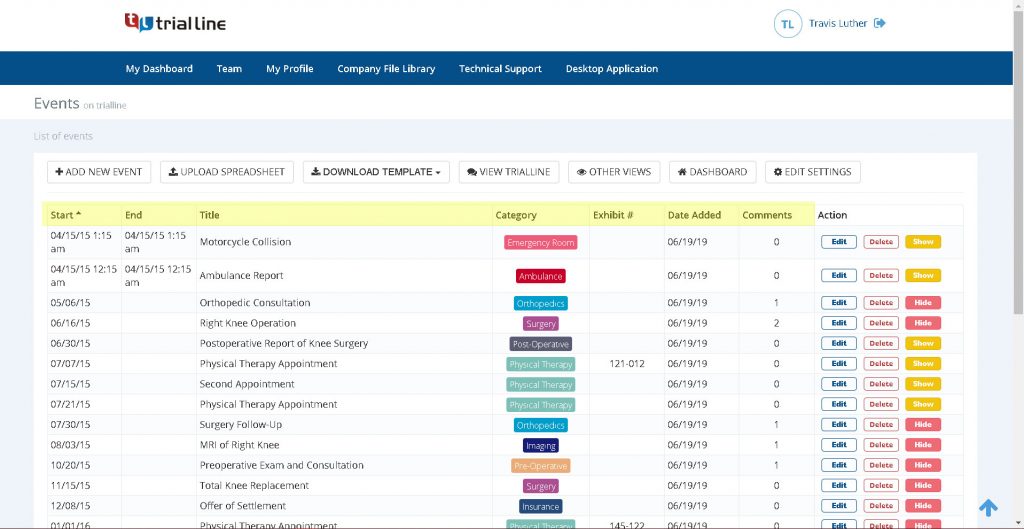
While we’ve discussed systematic approaches and technology broadly, platforms like TrialLine specifically address the challenges attorneys face when managing complex witness timelines. TrialLine is a cloud-based legal timeline software designed specifically for attorneys, offering features that streamline the witness tracking and contradiction-identification process.
How TrialLine Solves Witness Timeline Challenges
TrialLine allows attorneys to:
Build comprehensive witness timelines: Rather than maintaining witness information across multiple systems, TrialLine provides a unified platform where you can organize all witness-related events chronologically, attach relevant documents, and note timeline discrepancies.
Visualize witness accounts: The platform’s timeline visualization capabilities help you see witness accounts in graphical format, making contradictions and patterns immediately apparent.
Collaborate with your team: Multiple attorneys can view, edit, and contribute to witness timelines simultaneously, ensuring your entire team works from the same accurate information.
Search and filter efficiently: Rather than manually reviewing deposition transcripts, you can quickly search for specific events, times, or themes across all witness accounts.
Prepare for trial effectively: TrialLine’s visualization capabilities help you create compelling demonstrative exhibits that clearly show witness contradictions and strengthen your case presentation.
By consolidating witness information into a single, organized, visual format, TrialLine reduces the time you spend on administrative case management and increases the time you spend on strategic case analysis.
Frequently Asked Questions About Witness Timeline Management
Q: How detailed should witness timeline entries be?
A: Include enough detail to understand the event and identify contradictions, but avoid unnecessary verbosity. Generally, a few sentences describing what happened, when it happened, where it happened, and who was present is sufficient. You can always reference the original deposition or interview for additional context.
Q: Should I track every statement a witness makes, or only major events?
A: Focus on events that are material to your case. While you don’t need to track every minor detail, be comprehensive about events that relate to causation, liability, damages, or key issues in dispute.
Q: How can I manage contradictions between witnesses who witnessed different events?
A: Not all contradictions are equivalent. If witnesses witnessed different events or had different vantage points, you wouldn’t necessarily expect their accounts to perfectly align. Document the different perspectives, but focus contradiction analysis on witnesses who should have witnessed the same events.
Q: What should I do if I discover a contradiction in my own client’s testimony?
A: Address it immediately during witness preparation. Help your client understand where the contradiction exists and develop an explanation. It’s far better to address this proactively during preparation than to be blindsided by opposing counsel during trial.
Q: Can witness timeline software help with criminal cases differently than civil cases?
A: The fundamentals are similar, but criminal cases often involve more witnesses and more complex timelines. Timeline software is equally valuable in criminal practice, perhaps even more so given the complexity of many criminal cases.
Conclusion: Building a Stronger Case Through Systematic Witness Timeline Management
Tracking witness timelines and catching contradictions fast is not simply a matter of good legal housekeeping—it’s a fundamental litigation skill that directly impacts case outcomes. By implementing systematic processes, leveraging appropriate technology, and developing a strategic approach to witness analysis, you can:
- Identify contradictions early, when they’re easier to address and before they become trial problems
- Build a stronger case narrative, by thoroughly understanding the sequence of events as described by all witnesses
- Improve team collaboration, by ensuring all attorneys have access to organized, accurate witness information
- Present your case more persuasively, through clear, visual demonstrations of credibility and contradiction
- Reduce litigation costs, by preventing surprises at trial and facilitating more informed settlement discussions
The legal profession has historically relied on manual methods for managing witness information, and many attorneys continue using these approaches despite their limitations. However, the complexity of modern litigation increasingly demands more systematic, technology-enabled approaches.
Whether you implement a manual system with careful documentation protocols, leverage cloud-based legal timeline software, or combine both approaches, the key is establishing a structured process that ensures no witness contradiction is overlooked and no important temporal relationship is missed.
Next Steps to Improve Your Witness Timeline Management
Start today by identifying your most complex pending case and applying the principles outlined in this guide. Specifically:
- Gather all witness statements and deposition transcripts
- Extract key timeline events for each witness
- Create a chronological comparison showing where witnesses agree and disagree
- Document discrepancies and plan how you’ll address them
If your case involves numerous witnesses or complex temporal relationships, consider whether specialized timeline software like TrialLine might help you manage the information more efficiently and analyze patterns more effectively. Many attorneys find that the time savings and improved analysis capabilities quickly justify the investment in purpose-built legal timeline software.
Remember, the attorney who thoroughly understands their case’s timeline—including every contradiction, every point of agreement, and every temporal relationship—is invariably better prepared for trial, better positioned to negotiate settlements, and more likely to achieve favorable outcomes for clients.
Your witnesses’ stories matter tremendously. Make sure you’re capturing, organizing, and analyzing them in ways that maximize your case’s potential. By systematically tracking witness timelines and catching contradictions fast, you’re not just improving your case management—you’re building a stronger foundation for case success.