

The courtroom falls silent as the opposing counsel presents a carefully crafted narrative of events. Your client’s story, however compelling, begins to unravel under the weight of conflicting dates, misaligned facts, and scattered documentation. In that moment, you realize the devastating truth: you’re losing not because your legal argument is weak, but because your case timeline is broken.
This scenario plays out more often than you might think. Indeed, timeline errors represent one of the most overlooked yet catastrophic vulnerabilities in legal practice. Whether you’re handling a straightforward personal injury case or navigating the complexities of commercial litigation, a single chronological mistake can undermine your entire case strategy, damage credibility with judges and juries, and ultimately result in an unfavorable verdict.
In this comprehensive guide, we’ll explore why case timeline mistakes happen, how they sabotage legal cases, and most importantly, what you can do to prevent them. Additionally, we’ll examine how modern legal technology can transform the way you organize and present case events—ensuring your timeline becomes your strongest asset rather than your biggest liability.
The Hidden Cost of Timeline Disorganization
When you think about case losses, your mind probably jumps to legal arguments, procedural oversights, or insufficient evidence. However, the real culprit often hiding in plain sight is timeline confusion. Lawyers frequently underestimate how critical chronological accuracy is to case outcomes.
Consider the typical litigation workflow: Your firm receives a new case. Documents arrive in waves—sometimes complete, sometimes fragmented. Emails arrive out of order. Witness statements reference events by vague descriptions. Client communications span multiple formats. Meanwhile, your team members are managing this information across different platforms: emails, spreadsheets, document folders, and personal notes.
The result? A fragmented, inconsistent understanding of when events actually occurred. Moreover, when a judge or jury encounters conflicting timelines—either from your side or when contradicted by opposing counsel—they lose confidence in your narrative. This credibility gap is remarkably difficult to recover from, regardless of your legal theories or evidence quality.
Why Timeline Errors Are So Common
The legal profession has evolved significantly, yet case timeline management has largely remained stuck in the analog era. Consequently, attorneys continue relying on methods that are error-prone and time-consuming:
- Manual data entry: Lawyers manually create timeline spreadsheets, introducing transcription errors and typos that distort dates and facts
- Siloed information: Case details exist across email inboxes, cloud storage folders, case management systems, and physical documents—making it nearly impossible for all team members to access the same information simultaneously
- Version control nightmares: Multiple versions of timelines circulate among team members, creating confusion about which version is current and authoritative
- No visual representation: Text-based timelines fail to reveal patterns, gaps, or relationships between events that might be immediately obvious in graphical format
- Limited collaboration: Team members cannot simultaneously contribute to or verify timeline accuracy, leading to duplicated efforts and missed connections
Furthermore, many attorneys lack dedicated time to maintain and update timelines as new information emerges. What starts as a comprehensive timeline often becomes outdated as discovery progresses and new documents surface.
How Timeline Mistakes Damage Your Case Strategy
Understanding the mechanics of how timeline errors sabotage cases is essential for appreciating why prevention matters so profoundly. Let’s examine the specific ways that chronological mistakes undermine your litigation efforts.
Narrative Breakdown
Every successful case rests on a compelling narrative—a coherent story that connects facts, evidence, and legal theories into a persuasive whole. Your timeline is the backbone of this narrative. Specifically, it establishes the sequence of events that supports your legal theory and creates causality between facts.
When your timeline contains errors—whether missing events, incorrect dates, or misplaced documents—your narrative fragments. For example, in a products liability case, if your timeline incorrectly shows that the plaintiff used the product before receiving the warning materials, you’ve reversed the causal relationship your case depends on. Opposing counsel will exploit this relentlessly.
Credibility Destruction
Judges and juries make credibility assessments almost subconsciously. They’re constantly asking: “Do I trust what this attorney is telling me?” Your timeline communicates far more than just dates and events; it communicates your professionalism, thoroughness, and honesty.
A timeline filled with gaps, inconsistencies, or obvious errors signals carelessness at best and deception at worst. Therefore, even if the errors are innocent mistakes rather than intentional misrepresentations, the damage to your credibility can be irreversible. Once jurors begin doubting your attention to detail, they’re more likely to doubt your entire case.
Missed Opportunities for Case Strategy
Beyond simply presenting information accurately, timelines reveal strategic opportunities that disorganized case management obscures. For instance, in an employment discrimination case, a well-organized timeline might reveal a clear pattern: each time the plaintiff raised safety concerns, negative employment actions followed. This pattern becomes invisible if events are scattered across dozens of documents and emails.
Subsequently, by failing to create a clear, comprehensive timeline, you miss the chance to identify crucial patterns, demonstrate pretext, or establish relevant causality relationships. Your case strategy becomes reactive rather than proactive.
Vulnerabilities During Cross-Examination
During depositions and trial testimony, opposing counsel will ruthlessly attack any timeline inconsistencies. If a witness testifies that an event occurred on March 15th, but your timeline shows March 14th, suddenly opposing counsel has ammunition to question that witness’s credibility—and potentially your entire case narrative.
Therefore, having a comprehensive, thoroughly vetted timeline becomes your shield against these attacks. You can confidently address timeline questions because you’ve already verified dates against source documents and coordinated information across your team.
Real-World Consequences: When Timeline Errors Cost Cases
The Medical Malpractice Miscalculation
Consider a medical malpractice case where a surgeon negligently failed to order follow-up imaging after a procedure. The plaintiff’s injuries worsened significantly during the period when proper medical care would have prevented further damage. The timeline is everything—it must show clearly when the negligence occurred, when symptoms developed, and when proper care would have caught the problem.
In one actual case, the plaintiff’s attorney created a timeline showing the negligent procedure on January 15th, with recommended follow-up imaging “within 1-2 weeks.” However, due to poor document management, the attorney failed to include in the timeline three emails from the surgeon’s office dated January 8th—before the procedure—discussing scheduling follow-up imaging.
At trial, opposing counsel presented these overlooked emails, demonstrating that the surgeon had actually planned appropriate follow-up care. This single timeline oversight—an omission, not an error—transformed the narrative from “negligent failure to plan follow-up” to “patient neglected to attend scheduled appointments.” The jury found for the defendant.
The Commercial Litigation Date Reversal
In a breach of contract case, the timeline’s accuracy determines who breached first. If Party A performed its obligations on June 1st, but Party B failed to perform on July 15th, Party B is clearly in breach. However, if your timeline incorrectly reverses these dates due to data entry errors, you’ve surrendered your case.
A mid-sized law firm representing a software company misrepresented the sequence of email communications due to relying on email timestamps rather than verifying them against calendar invitations and receipts. The opposing party had actually breached first, but the confused timeline made it appear the plaintiff was the initial wrongdoer. The case settled unfavorably as a result.
The Employment Case Pattern Obscuration
In an employment discrimination case, the plaintiff’s attorney needed to establish a pattern of race-based discrimination. The pattern existed—promotion denials following complaints, negative performance reviews that contradicted prior evaluations, sudden disciplinary actions—but these events were scattered across multiple years and multiple documents.
Because the attorney never created a clear, visual timeline showing all these events in sequence, the pattern remained invisible in depositions and discovery responses. When the case reached summary judgment, opposing counsel successfully argued that individual decisions were based on legitimate business reasons, not discrimination. Meanwhile, a comprehensive timeline would have made the pattern unmistakable.
The Three Primary Categories of Timeline Mistakes
Understanding how timeline errors occur helps you implement prevention systems. Most mistakes fall into three distinct categories:
1. Chronological Errors
These are straightforward date mistakes—transposing numbers, misreading dates, or incorrectly entering dates into your timeline system. While seemingly simple, date errors have outsized consequences because they fundamentally alter the sequence of events your case depends on.
For example: Entering a contract signing date as November 13th instead of November 31st seems minor—except November only has 30 days, signaling an immediate data quality problem. Moreover, if this date error affects when parties knew about key terms, it undermines your entire breach of contract analysis.
2. Omission Errors
These occur when critical events disappear from your timeline entirely. Perhaps a document was never uploaded to your case management system. Maybe an email was deleted before being captured. Conceivably, a team member forgot to mention a crucial conversation.
Omission errors are particularly insidious because they’re invisible. You don’t know what you’re missing. Therefore, comprehensive document review and team communication protocols become essential to preventing these gaps.
3. Context and Connection Errors
Sometimes all the individual facts are correct, but their relationships to each other are misunderstood. For instance, your timeline might correctly show that a witness observed something on April 3rd, but fail to connect this observation to a critical contract provision discussed on April 2nd. Without these connections, individual facts fail to create the narrative coherence your case requires.
Building Better Timeline Management Into Your Practice
Now that we’ve examined why timeline mistakes happen and how they damage cases, let’s focus on practical solutions. Implementing robust timeline management systems protects your cases and enhances your legal strategy.
Establish a Timeline Protocol
First and foremost, develop a written protocol for timeline creation and maintenance. This protocol should specify:
- Who is responsible for creating initial timelines and maintaining them as new information emerges
- What documents must be reviewed before the timeline is considered complete
- How dates will be verified against source documents rather than assumptions
- When timelines will be reviewed by multiple team members for accuracy verification
- What format timelines will use for consistency across all cases
Subsequently, this protocol becomes your quality control checklist. Rather than relying on individual attorney practices, you’ve systematized timeline accuracy.
Implement Comprehensive Document Review
Timeline accuracy depends entirely on the completeness and accuracy of your source material. Therefore, establish systematic document review procedures:
- Centralize all documents in a single location with consistent naming conventions
- Timestamp every document with its received date, not just its creation date
- Create an index of all documents by date range, making gaps immediately visible
- Verify dates against multiple sources—email headers, document metadata, witness statements, and communications
- Flag anomalies such as documents created before they logically should exist
This thorough approach identifies missing documents and date discrepancies before they become case liabilities.
Establish Team Review Procedures
Because timelines represent the collective knowledge of your entire legal team, multiple people should verify them. Specifically:
- Have case team members independently verify sections of the timeline related to their work
- Conduct team timeline meetings where events are discussed and date accuracy is confirmed
- Use these meetings as discovery opportunities—team members often remember details that weren’t formally documented
- Document any disagreements about event dates or sequences for further investigation
This collaborative approach leverages your team’s collective knowledge while creating accountability for accuracy.
Create Visual Representations
Text-based timelines alone often fail to reveal patterns or gaps. Therefore, creating visual representations—graphical timelines showing events in chronological order—serves multiple purposes:
- Patterns become obvious when you can see events arranged visually in chronological sequence
- Gaps become apparent when you visually scan timeline entries and notice missing periods
- Relationships between events clarify when you can see which facts occurred in proximity
- Non-lawyer decision-makers (judges, juries, clients) understand visual timelines more readily than written ones
Moreover, visual timelines become powerful presentation tools during trial, client meetings, and witness examinations.
How Modern Timeline Software Transforms Case Management
While institutional protocols and manual processes improve timeline accuracy significantly, modern legal technology can elevate your timeline management to a new level entirely. Cloud-based timeline software specifically designed for attorneys solves many inherent challenges of manual timeline management.
The Advantages of Specialized Legal Timeline Software
Centralized information access: Rather than scattered information across emails, documents, and notes, a comprehensive timeline software platform consolidates all case events and documents in one accessible location. Furthermore, all team members access the same information simultaneously, eliminating version control problems and ensuring consistent understanding of the case narrative.
Automated date verification: While software cannot make judgment calls about date accuracy, it can flag discrepancies and ensure consistency across references to the same event. Specifically, if an event is mentioned multiple times with different dates, the software highlights this conflict for human review.
Visual timeline generation: Rather than manually creating visual timelines, software automatically generates graphical representations of chronological events. These visualizations immediately reveal patterns, gaps, and relationships that text-based timelines obscure.
Document integration: Quality timeline software allows you to attach source documents directly to timeline events. Consequently, you can instantly verify dates against original documents, and juries can see the documentary evidence supporting your timeline narrative.
Collaboration capabilities: Multiple team members can simultaneously view, edit, and contribute to timelines. Therefore, attorneys in different locations work from identical, continuously updated information. Additionally, collaborative platforms create clear audit trails showing when information was added and by whom.
Cloud-based accessibility: Because timeline software operates in the cloud, attorneys access their cases from any internet-connected device. This means you can review case timelines from courtrooms, client meetings, depositions, or while traveling—ensuring you always have complete case information at your fingertips.
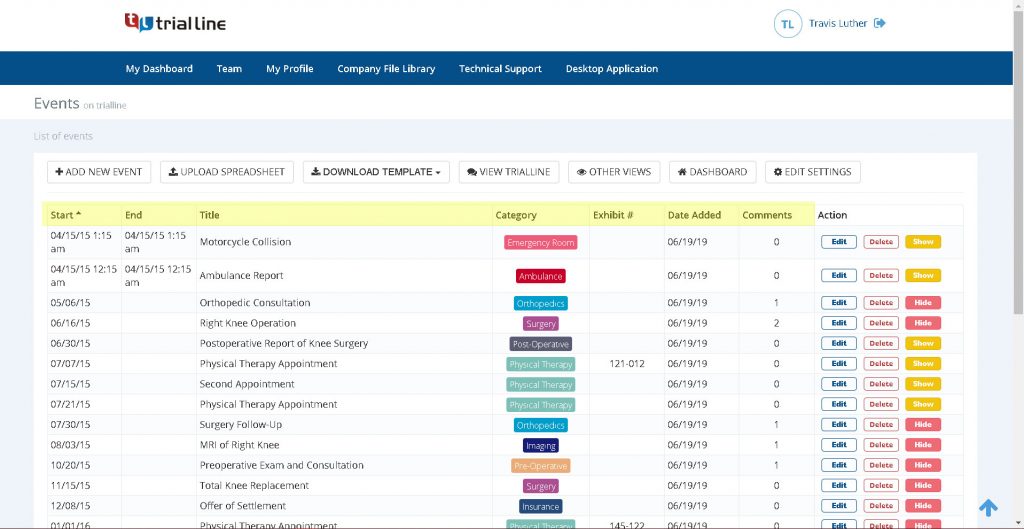
Platform like TrialLine exemplifies these advantages. Specifically designed for legal professionals, TrialLine enables attorneys to create detailed, interactive case timelines with full document integration, team collaboration features, and powerful visualization capabilities. The platform eliminates the time-consuming manual work of timeline management while dramatically improving accuracy and strategic insight.
Key Takeaways: Protecting Your Cases Through Timeline Excellence
As we conclude our examination of why timeline mistakes damage cases, several critical principles emerge:
First, recognize that timeline accuracy is not a peripheral concern—it’s central to case success. Your timeline is not merely administrative documentation; it’s the foundation of your case narrative and a primary vehicle for communicating your case to judges, juries, and clients.
Second, understand that timeline errors occur through systemic problems, not individual carelessness. Manual processes, siloed information, and lack of verification procedures create environments where mistakes flourish. Therefore, addressing these systemic issues prevents problems rather than correcting them after they’ve caused damage.
Third, implement both procedural improvements and technological solutions. Written protocols and team procedures substantially improve timeline accuracy. However, specialized legal timeline software amplifies these improvements by automating data management, enabling real-time collaboration, and creating visual representations that reveal insights manual timelines miss.
Finally, recognize that investing in timeline excellence provides competitive advantage. Attorneys who present clear, comprehensive, verified timelines gain credibility. Their case narratives are more persuasive. Their strategic insights are sharper. Consequently, they win more cases and better serve their clients.
Making the Transition to Better Timeline Management
If you’re currently managing case timelines manually or through general-purpose tools not designed for legal practice, the path forward is clear. Consider these action steps:
- Audit your current process: Examine how you currently create and maintain timelines. Identify where errors occur and which manual steps consume the most time.
- Implement protocol improvements: Develop written timeline procedures that standardize date verification, document review, and team verification processes.
- Explore legal timeline software: Research tools specifically designed for attorneys, such as TrialLine, that consolidate timeline management with document integration and collaboration features.
- Run a pilot program: Implement new timeline procedures or software on one case before deploying firm-wide, allowing you to identify and address challenges in controlled circumstances.
- Train your team: Ensure all attorneys and staff understand new timeline procedures and how to use new software tools effectively.
The stakes are too high to leave timeline accuracy to chance. Your cases depend on getting the chronological details right. Your clients depend on your attention to these crucial details. Your reputation depends on presenting timelines that stand up to scrutiny.
By implementing robust timeline management procedures and leveraging specialized legal technology, you transform timelines from a vulnerable point in your practice into a distinctive strength—ensuring that your case narrative is clear, compelling, and most importantly, chronologically sound.