
The witness sits across the table, confident and composed. They’ve prepared thoroughly for this deposition, and their story seems airtight. But then you notice something peculiar—they mention an event occurring on Tuesday, yet earlier testimony placed them in a different location on that same day. It’s a small detail, easily missed, but potentially case-changing.
Timeline inconsistencies are the hidden landmines of depositions. They’re often overlooked by unprepared attorneys, yet they can become the pivotal evidence that undermines an opponent’s entire narrative. The ability to spot these discrepancies—and more importantly, to know how to exploit them—separates exceptional trial lawyers from the merely competent.
In this guide, we’ll explore the techniques that experienced trial attorneys use to identify timeline conflicts, understand why these inconsistencies matter so much during depositions, and discover how proper case organization can give you a competitive edge that helps you win.
The Hidden Power of Timeline Inconsistencies in Depositions
Before diving into detection techniques, let’s understand why timeline inconsistencies carry such weight in depositions and trial strategy.
Timeline inconsistencies serve as credibility markers. When a witness contradicts themselves regarding dates, sequences of events, or the timing of communications, jurors naturally question their reliability. Indeed, jurors rely heavily on witness credibility to determine case outcomes. A single timeline contradiction can cast doubt on everything a witness says, even unrelated testimony.
Furthermore, timeline inconsistencies often reveal deception or faulty memory. In many cases, witnesses who are fabricating details struggle to maintain consistency across multiple recollections. Conversely, honest witnesses with accurate memories typically maintain consistent timelines, even under rigorous questioning. For this reason, inconsistencies frequently indicate that someone is either lying or significantly misremembering critical events.
Additionally, timeline conflicts can expose gaps in an opponent’s narrative. When events don’t align logically or when there are unexplained periods, these gaps create reasonable doubt. In contract disputes, employment litigation, and personal injury cases, such gaps can be devastating to the opposing party’s case.
Moreover, timeline inconsistencies can reveal collusion or coordination. When multiple witnesses present identical timelines that don’t align with documentary evidence, it suggests coaching or fabrication. Conversely, naturally occurring minor variations in honest witnesses’ timelines actually strengthen credibility.
How to Prepare: Building Your Timeline Foundation
The key to spotting timeline inconsistencies lies in meticulous preparation. You cannot identify what you haven’t organized.
Establish a Master Timeline from the Outset
Before the deposition, create a comprehensive master timeline incorporating all known facts from documents, prior statements, and discovery materials. This timeline should include:
- Specific dates and times from documents (emails, texts, contracts, medical records)
- Sequence of events from all parties’ perspectives
- Witness movements and locations as established by evidence
- Communication records with precise timestamps
- Third-party corroboration such as security footage, GPS data, or billing records
This master timeline becomes your foundation for comparison. During the deposition, any testimony deviating from established documentary evidence becomes a potential inconsistency worth exploring.
Color-Code Your Timeline Elements
Develop a systematic approach to distinguishing between different types of evidence:
- Objective evidence (documents, photographs, timestamps)
- Prior witness statements (sworn testimony, depositions, interviews)
- Current deposition testimony (what the witness is saying now)
Subsequently, as you conduct the deposition, you can quickly identify when current testimony conflicts with objective or prior evidence.
Note Gaps in the Timeline
Pay particular attention to periods without corroborating evidence. For example, if a defendant claims to have been at home between 2 PM and 5 PM on a critical date, yet no objective evidence supports this, that gap becomes significant. During the deposition, you can explore how the witness accounts for these unverified periods.
Key Techniques for Spotting Inconsistencies During Depositions
Now that you’ve prepared your foundation, here are proven techniques for identifying timeline inconsistencies in real-time.
1. Ask for Specific Dates and Times Early
Begin your deposition by establishing a clear timeline of events directly from the witness. Don’t reference your documents initially. Rather, allow the witness to provide their own chronology first. Specifically, ask:
- “Can you tell me the exact date when this meeting occurred?”
- “What time did you arrive at the location?”
- “How long did the conversation last?”
- “What day of the week was this event?”
Document every answer with precision. Subsequently, you can compare these statements against documentary evidence later in the deposition.
2. Use the “Pin Down” Technique
Once a witness provides a timeline detail, lock them into it through careful questioning. For instance:
- “So you’re certain the meeting was on March 15th?”
- “You’re sure about that time—3:47 PM?”
- “You’re telling me this conversation happened before you left the office?”
By forcing witnesses to commit to specific details, you eliminate wiggle room. Subsequently, any contradictions become stark and difficult to explain away.
3. Create Visual Comparisons During the Deposition
Prepare printed copies of your master timeline to reference during questioning. As the witness provides testimony, mark their statements on your copy. Notably, physical documentation of deviations helps both you and the court reporter track inconsistencies clearly.
Better yet, if your timeline is organized in a digital format, you can quickly reference specific dates and cross-check witness statements against documentary evidence in real-time. This approach prevents witnesses from slipping past subtle inconsistencies.
4. Cross-Reference Documents Strategically
Rather than presenting all documents at once, introduce them strategically throughout the deposition to highlight timeline conflicts. For example:
- Ask about an event: “When did you receive the contract?”
- Wait for the answer
- Then present the email timestamp: “I’m showing you an email dated March 10th. Does this refresh your memory?”
This technique catches witnesses comparing notes mentally and forces them to reconcile their memory with facts.
5. Explore Causation and Logical Sequence
Timeline inconsistencies often surface when examining the logical sequence of events. Ask questions about cause and effect:
- “After you received that email, what did you do?”
- “How long did it take before you responded?”
- “Between this call and your next action, what occurred?”
Witnesses often struggle to maintain logical sequencing when fabricating details. Subsequently, inconsistencies in causation reveal that their timeline doesn’t hold together logically.
6. Question Communication Timing Carefully
Communications—emails, text messages, phone calls—provide exact timestamps. Use these to your advantage:
- Present the email timestamp first
- Ask the witness when they believe they sent/received it
- Note any discrepancies
- Explore whether the witness might be confused about multiple similar communications
For instance, if a witness claims they sent an email “around noon” but the timestamp shows 4:37 PM, that discrepancy deserves exploration.
Red Flags That Indicate Potential Timeline Issues
Develop an instinct for recognizing when timeline inconsistencies are likely lurking beneath the surface.
Vague Language About Timing
When witnesses use imprecise language regarding timing, inconsistencies often follow. Listen for phrases such as:
- “Sometime that week”
- “I think it was around then”
- “Maybe a few days later”
- “Approximately that time”
These vague references suggest uncertain memory. Subsequently, when you compare them against specific documentary evidence, contradictions emerge.
Contradictions Regarding “Before” and “After”
One of the most common timeline inconsistencies involves the sequence of events. A witness might testify:
- “I learned about the problem, then I contacted my supervisor”
Yet documentary evidence shows:
- They contacted the supervisor before any reasonable point they could have learned about the problem
This type of inconsistency is crucial because it often implies consciousness of guilt or demonstrates fabrication.
Different Versions Across Multiple Questions
If a witness provides different details when asked about the same event through different angles, inconsistency exists. For example:
- When asked about a meeting, the witness says it occurred on Tuesday at 2 PM
- Later, when asked about a conversation that happened “at the meeting,” the witness indicates it was a phone call
- Subsequently, when pressed about details, they claim it was an in-person meeting
Notably, these shifting descriptions suggest the witness is confused or being untruthful.
Inconsistent Details About Location
Timeline inconsistencies frequently involve location claims. For instance:
- A witness claims they were in Conference Room A during a specific time period
- Yet email evidence shows they were corresponding from another building
- Additionally, security footage might place them elsewhere
These location inconsistencies undermine credibility and call into question what the witness actually observed or did during that timeframe.
Documenting Inconsistencies: The Court Reporter’s Best Friend
As you identify inconsistencies, ensure they’re clearly documented in the deposition record.
Request Clarification on the Record
When you spot a potential inconsistency, address it immediately and clearly:
- “I want to make sure I understand your testimony correctly. Earlier you stated [statement A]. You’re now indicating [statement B]. Can you explain the difference?”
By addressing inconsistencies contemporaneously, you create a clear record that contradicts cannot be explained away later as a misunderstanding.
Use the Deposition Summary Effectively
At the end of the deposition, consider requesting the witness review a summary of key timeline points. Ask them to confirm or correct their timeline testimony. Subsequently, this creates additional opportunity to lock in testimony or identify additional inconsistencies.
Create a Deposition Timeline Chart
Immediately after the deposition concludes, create a detailed chart comparing the witness’s testimony to documentary evidence. This document becomes invaluable for trial preparation and settlement discussions.
The TrialLine Advantage: Organizing Timelines for Deposition Success
Manually tracking timeline inconsistencies across multiple documents, prior statements, and current testimony is challenging and error-prone. This is where specialized legal technology becomes indispensable.
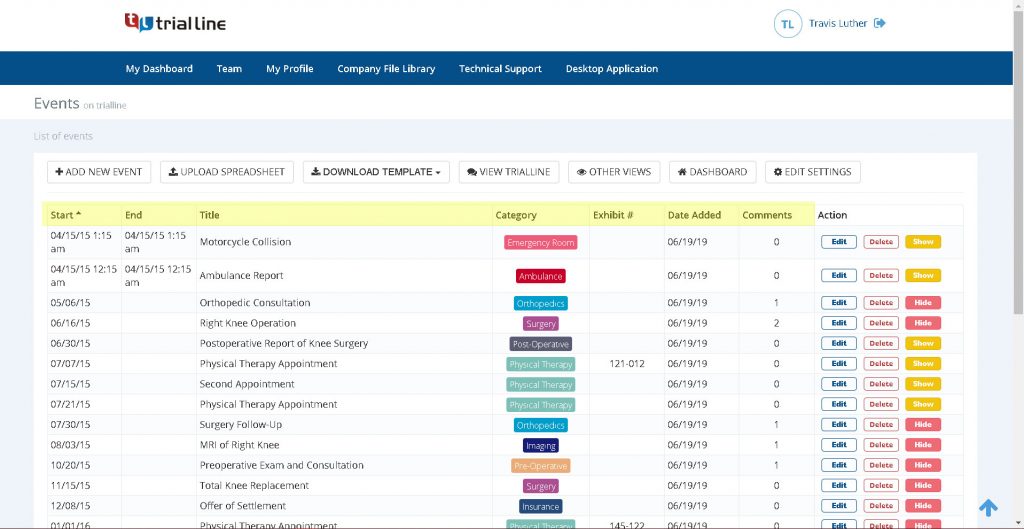
TrialLine is a cloud-based legal timeline software designed specifically for attorneys managing complex cases. Rather than juggling spreadsheets and scattered documents, TrialLine enables you to:
Visualize Complex Timelines Clearly
TrialLine’s interactive timeline visualization presents all case events in chronological order with attached supporting documents. Subsequently, as you prepare for depositions, you can instantly see the complete picture of what happened and when. This visual clarity helps you identify gaps and inconsistencies before the deposition begins.
Integrate Documents Directly with Events
Unlike general project management tools, TrialLine allows you to attach emails, photographs, medical records, contracts, and other evidence directly to specific timeline events. Therefore, during deposition preparation and the deposition itself, you have immediate access to corroborating evidence without searching through document folders.
Collaborate Across Your Legal Team
When multiple attorneys are working on complex litigation, ensuring everyone has the same timeline understanding is critical. TrialLine’s collaboration features allow your entire team to view, edit, and contribute to the case timeline simultaneously. Additionally, this ensures consistency in how your team understands and presents the case sequence.
Access Timelines from Anywhere
Since TrialLine is cloud-based, you can access your complete case timeline from your office, the courthouse, or a deposition location. Therefore, if you need to quickly reference a detail during questioning, the information is instantly available on your device.
Identify Inconsistencies Systematically
By organizing all evidence chronologically in one location, TrialLine makes inconsistencies visually apparent. You can quickly see when witness testimony doesn’t align with dated documents, creating a systematic approach to inconsistency detection.
Advanced Strategies: Using Timeline Inconsistencies Strategically
Once you’ve identified timeline inconsistencies, how should you use them in your deposition strategy?
The Progressive Revelation Method
Rather than confronting a witness with all inconsistencies at once, employ the progressive revelation method. First, establish the witness’s testimony on a particular point. Next, gently introduce corroborating documents that suggest inconsistency. Finally, when the witness cannot reconcile their testimony with the evidence, press more forcefully.
This approach prevents witnesses from recognizing your entire strategy and adjusting their testimony accordingly.
Don’t Lead Too Obviously
Although leading questions are permitted in depositions, using them too frequently can make your strategy transparent. Instead, ask open-ended questions that allow witnesses to provide detailed answers. Subsequently, their own words create the inconsistency, making it harder for them to claim misunderstanding.
Explore Motivations Behind Inconsistencies
When you identify an inconsistency, explore why it might exist:
- Is the witness confused about the timeline?
- Are they protecting themselves or others?
- Could they be protecting a business relationship or job?
- Might they benefit from an inconsistent version of events?
By exploring motivations, you help jurors understand whether the inconsistency represents honest confusion or intentional deception.
Frequently Asked Questions About Timeline Inconsistencies
Q: Should I always point out timeline inconsistencies during the deposition?
A: Not necessarily. While some inconsistencies should be addressed immediately to lock in testimony, others might be more strategically valuable if addressed later in trial. Consider whether your immediate correction provides strategic advantage or if saving it for trial amplifies impact.
Q: What if a witness admits to confusion about the timeline?
A: An admission of confusion is valuable. Jurors view confused witnesses skeptically. Subsequently, if the witness cannot maintain a consistent timeline, their overall credibility suffers, even if they’re honest about the confusion.
Q: How do I distinguish between honest timeline mistakes and intentional deception?
A: Honest timeline errors typically show logical consistency in other areas, whereas intentional deception creates multiple, cascading inconsistencies. Additionally, honest witnesses usually acknowledge confusion readily, while deceptive witnesses often insist on accuracy despite contradictions.
Q: Can timeline inconsistencies affect settlement negotiations?
A: Absolutely. Timeline inconsistencies significantly impact case value. When you can demonstrate that opposing witnesses have given contradictory timeline testimony, it weakens their case considerably. Consequently, opposing counsel becomes more motivated to settle favorably.
Practical Checklist: Preparing for Timeline-Focused Depositions
Before your next deposition, use this checklist to ensure you’re prepared to spot inconsistencies:
- [ ] Create a master timeline from all documentary evidence
- [ ] Color-code different types of evidence (objective, prior statements, etc.)
- [ ] Identify gaps in the timeline requiring witness explanation
- [ ] Prepare specific questions establishing the witness’s timeline
- [ ] Organize documents strategically for reference during deposition
- [ ] Note key dates and times to “pin down” with the witness
- [ ] Consider visual aids or charts to compare witness testimony against evidence
- [ ] Plan your progressive revelation strategy
- [ ] Identify which inconsistencies to address immediately versus saving for trial
- [ ] Arrange for immediate post-deposition timeline documentation
Leveraging Technology for Timeline Analysis
In today’s legal practice, technology should support your timeline analysis. Beyond TrialLine’s specialized capabilities, consider:
- Using document management systems that preserve email timestamps and metadata
- Employing spreadsheet tools with sorting and filtering capabilities
- Creating visual timeline presentations for trial
- Using video deposition platforms that allow timestamped markers
However, general-purpose tools often lack the specialized features attorneys need for complex case timelines. TrialLine’s purpose-built approach specifically addresses legal timeline management, making it substantially more efficient than adapting general tools.
Conclusion: Timeline Mastery Wins Cases
Timeline inconsistencies are among the most powerful tools in a trial attorney’s toolkit. When you can demonstrate that opposing witnesses cannot maintain consistent chronological accounts, you’ve fundamentally undermined their credibility and case strength.
The attorneys who consistently win depositions and trials aren’t necessarily the most aggressive questioners. Rather, they’re the most thoroughly prepared, the most systematic in their approach, and the most skilled at identifying and exploiting the small inconsistencies that reveal truth.
By implementing the techniques outlined in this guide—meticulous preparation, strategic questioning, visual comparison tools, and thorough documentation—you’ll dramatically improve your ability to spot timeline inconsistencies during depositions. Moreover, you’ll create a record of contradictions that’s invaluable throughout litigation.
Next Steps to Improve Your Timeline Analysis
- Review your current case timelines: Examine how you’re currently organizing case events. Are you using scattered documents, spreadsheets, or a more systematic approach?
- Implement a timeline organization system: Whether through TrialLine or another method, establish a systematic approach to chronological case management.
- Train your legal team: Ensure all team members understand your timeline approach and can identify inconsistencies systematically.
- Apply these techniques in your next deposition: Choose your next complex case to implement these timeline inconsistency detection strategies.
- Document your results: Track how timeline inconsistency identification affects your deposition effectiveness and case outcomes.
Timeline mastery isn’t complicated, but it does require systematic organization and disciplined preparation. The attorneys who invest in these fundamentals consistently outperform those who rely on improvisation. Your next case-winning inconsistency might be hiding in the details right now—the question is whether you’ll be prepared to find it.