
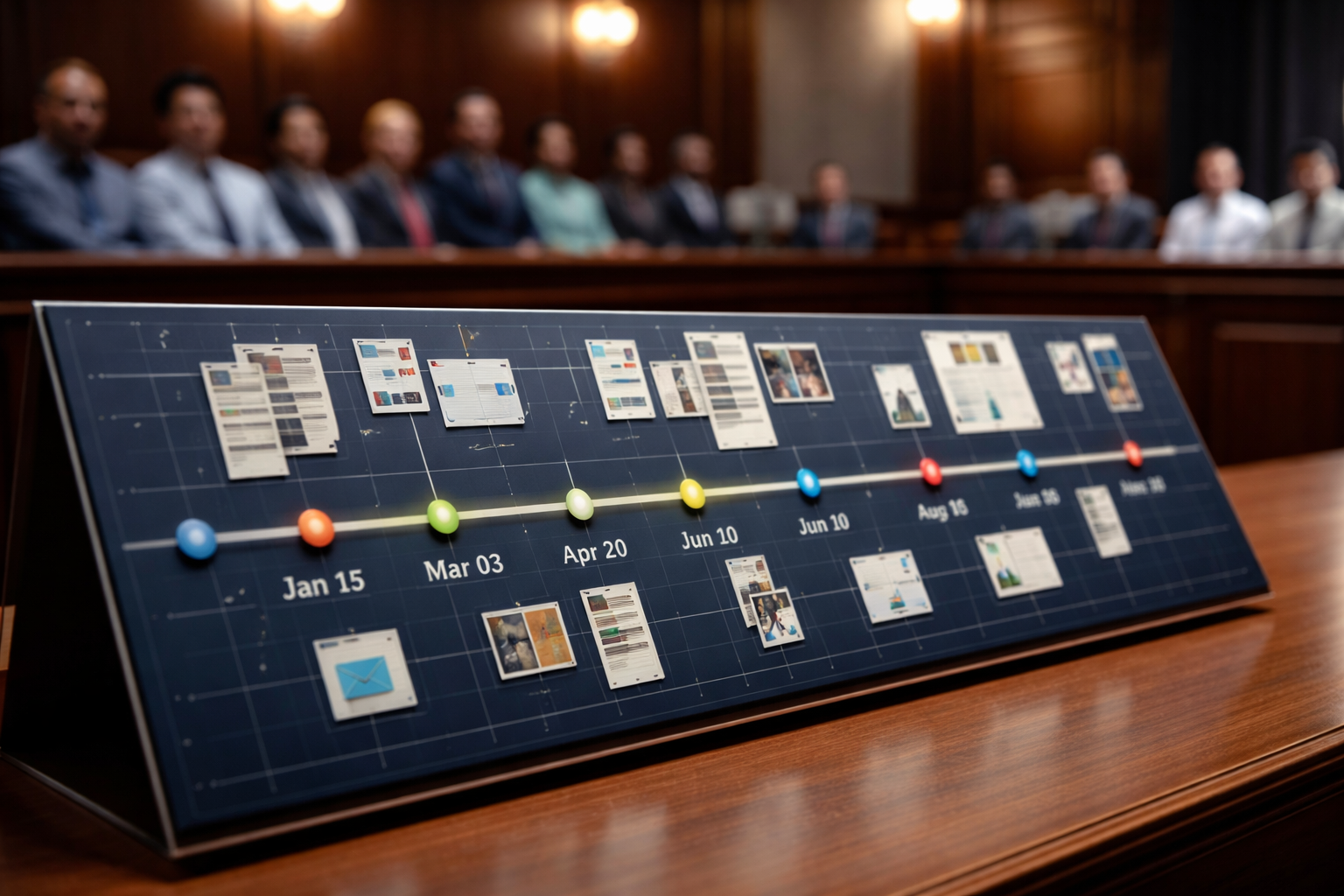


How Strong Timelines Improve Jury Comprehension

Jurors don’t walk into a courtroom as blank slates. They arrive with life experience, instinct, and a limited amount of mental bandwidth to process unfamiliar names, dense exhibits, and competing narratives—often delivered under time pressure. Your job isn’t just to present facts. It’s to help ordinary people understand those facts well enough to make confident decisions.

One of the most reliable ways to do that is simple: organize the story in time.

A strong timeline doesn’t “dumb down” a case. It clarifies it. It reduces confusion, surfaces relationships between events, and gives jurors a sturdy framework to evaluate credibility. Most importantly, it lets them feel oriented—like they know where they are in the story and why each moment matters.

Below is a practical, trial-focused look at why timelines work, how they improve jury comprehension, and how to build timelines that actually persuade.


Why jurors struggle to follow case facts

Even straightforward disputes can become hard to track at trial. That’s not because jurors aren’t paying attention—it’s because the environment is cognitively demanding.

Common comprehension obstacles include:

  • Nonlinear presentation: Witness order rarely matches event order. Jurors may hear about the aftermath before the beginning.
  • Competing storylines: Each side offers a different “why,” even when the “what” overlaps.
  • Information overload: Dates, times, locations, medical visits, emails, text messages, policies, phone calls—stacked quickly.
  • Ambiguous labels: “That meeting,” “the incident,” “the second call,” “the revised form”—without anchors, everything blurs.
  • Memory limits: Jurors are expected to remember details across days or weeks and then deliberate later.

When jurors lose the thread, they fill gaps using assumptions. That’s risky. If you don’t control the structure, the structure controls you.

A timeline restores the thread.


The mental advantage of chronological structure

Humans naturally process stories in sequence: this happened, then that happened, and because of that, this happened next. When you align your case with how the brain wants to understand events, jurors expend less energy trying to decode the order and more energy evaluating meaning.

A timeline helps jurors:

  • Build a “map” of the case
  • Place each piece of evidence somewhere specific
  • Detect inconsistencies
  • Understand cause and effect
  • Compare accounts across witnesses
  • Stay engaged because they aren’t lost

Chronology becomes a container. Without a container, facts leak.


The hidden jury question: “What connects all of this?”

Jurors rarely ask themselves, “What’s the legal standard?” first. They ask:

  • What happened?
  • Who did what?
  • When did they know it?
  • What changed—and why?
  • Does this explanation make sense over time?

A timeline answers those questions continuously, without requiring jurors to do extra work.

It also gives jurors a way to test competing narratives. If one side’s story requires improbable timing—instant decisions, missing steps, unexplained delays—jurors feel that friction when events are laid out clearly.


Timelines reduce cognitive load—and that boosts persuasion

Persuasion doesn’t come only from passion. It comes from comprehension.

If jurors are mentally exhausted trying to remember whether Event A came before Event B, they have less capacity left to evaluate credibility, motive, or intent. A good timeline:

  • Minimizes confusion by anchoring details to dates and sequences
  • Improves recall by tying evidence to a consistent structure
  • Creates momentum because the story moves forward cleanly
  • Sharpens contrast between “what should have happened” and “what did happen”

This isn’t just about being organized. It’s about giving jurors a smoother path to the conclusion you want them to reach.


The credibility effect: timelines expose contradictions

Contradictions are harder to see when testimony is scattered across hours or days of trial. A timeline brings inconsistencies into the light without you needing to argue about them.

For example:

  • A witness claims they reported an issue immediately, but the report appears weeks later.
  • A company claims it acted promptly, but key steps are missing in the sequence.
  • A defendant claims they didn’t know, but a chain of emails shows earlier awareness.
  • An expert assumes a condition existed before an incident, but medical visits show otherwise.

When jurors see the sequence cleanly, they can draw their own conclusions. And conclusions jurors reach themselves are the hardest for the other side to uproot.


Causation becomes clearer when “before” and “after” are undeniable

In many cases, causation is the battlefield.

Timelines help jurors evaluate causation by clarifying:

  • Baseline conditions (what was true before the key event)
  • Triggering events (what changed)
  • Immediate consequences (what happened right after)
  • Delayed consequences (what surfaced later and why that delay makes sense)
  • Intervening factors (what else occurred that may explain outcomes)

When you control the sequence, you control how jurors think about cause and effect. Not by manipulating—but by making the true relationship between events visible.


Strong timelines improve deliberations

You’re not only presenting to jurors during trial—you’re equipping them for the jury room.

In deliberations, jurors typically:

  • reconstruct the story in their own words
  • debate turning points (“when did they know?” “what did they do next?”)
  • compare testimony to documents
  • look for a coherent narrative that fits the evidence

A timeline gives them a shared reference point. It helps them align as a group, resolve disagreements about order, and focus on disputed facts rather than getting stuck in confusion.

In other words: a timeline doesn’t stop working after closing argument. It keeps working when you’re no longer in the room.


What makes a timeline persuasive (not just pretty)

Not all timelines help. Some overwhelm jurors with clutter. Some feel like a data dump. The strongest timelines are both accurate and intentional.

A persuasive timeline is:

1) Selective, not exhaustive

Include what matters. If everything is highlighted, nothing is highlighted.

Ask: Does this event change the story, prove a point, or explain a decision?
If not, it may belong in your internal chronology but not the jury-facing version.

2) Legible at a glance

Jurors shouldn’t need to squint or “study” it like a spreadsheet.

Aim for:

  • short event descriptions
  • consistent date format
  • clean spacing
  • limited items per page or panel

3) Anchored to exhibits

A timeline gains power when jurors can connect events to concrete proof.

Where appropriate, pair key entries with:

  • exhibit numbers
  • document titles
  • witness names
  • communication types (email, call, text, report)

4) Built around turning points

A timeline shouldn’t be a calendar—it should be a story.

Most cases have 3–7 major pivots. Examples:

  • first notice
  • first decision
  • first deviation from policy
  • escalation
  • concealment or denial
  • final consequence

When your timeline emphasizes pivots, jurors remember the case in a meaningful way.

5) Consistent with your theme

Your theme is your “why.” Your timeline is your “how it unfolded.”

If your theme is “they ignored warnings,” then your timeline should make warnings—and the lack of action afterward—impossible to miss.

A well-built legal timeline becomes the backbone of that thematic message.


Where timelines fit into trial strategy

A timeline is useful at every stage—if you design it to match the purpose.

Case development

  • identify missing documents
  • find unexplained gaps
  • test whether your theory matches the record
  • see where witnesses will help or hurt

Depositions

  • lock in dates and sequences
  • confront witnesses with contemporaneous documents
  • reveal “I don’t recall” patterns around key moments

Motions and mediation

  • present a coherent narrative quickly
  • show liability or causation clearly
  • demonstrate why the other side’s story doesn’t fit the timeline

Opening statement

  • give jurors a roadmap before details start flying
  • reduce confusion when witnesses come out of order

Direct and cross examination

  • keep jurors oriented (“Let’s place this on the timeline…”)
  • highlight contradictions cleanly
  • prevent the other side from isolating facts out of context

Closing argument

  • reconstruct the case in a memorable sequence
  • emphasize the turning points and failures
  • give jurors a final, coherent story to take into deliberations

A practical method to build a jury-friendly timeline

Here’s a straightforward approach that works across civil and criminal cases.

Step 1: Create the master chronology (everything)

Build a complete internal chronology first—every document date, call, visit, meeting, change, and communication.

Don’t worry about elegance yet. Worry about completeness.

Step 2: Identify the “spine” (the case in 10–20 events)

Now select the handful of events that:

  • establish duty/relationship
  • show notice/knowledge
  • demonstrate decisions and omissions
  • connect conduct to outcome
  • support damages or consequences

This is the version a juror could retell accurately.

Step 3: Add “support ribs” (optional, only if needed)

If jurors will ask “how do we know that?” add limited supporting entries that:

  • corroborate the spine
  • explain delays
  • clarify a confusing transition

Step 4: Label turning points explicitly

Use simple language:

  • “First warning”
  • “Policy change”
  • “Deadline missed”
  • “Escalation”
  • “After-the-fact explanation”

You’re not editorializing—you’re guiding comprehension.

Step 5: Pressure test for clarity

Hand it to someone unfamiliar with the case and ask:

  • “What happened?”
  • “When did things change?”
  • “What are the biggest moments?”

If they can’t summarize it, jurors will struggle too.


Common timeline mistakes that hurt comprehension

Even strong cases can suffer from timeline errors. Avoid these pitfalls:

  • Overcrowding: too many entries; jurors stop reading
  • Inconsistent time units: mixing exact times with vague “early 2023” without reason
  • Unexplained gaps: leaving holes where jurors will assume the worst
  • Ambiguous phrasing: “discussion,” “issue,” “matter,” “concern” without specifics
  • No narrative emphasis: a list of events with no clear turning points

A timeline should feel like a story unfolding—not like a case file spilled onto a page.


Why this matters: comprehension drives confidence

Jurors don’t want to guess. They want to be right.

When they understand the sequence, they feel more confident in:

  • identifying who is credible
  • deciding what happened
  • applying the judge’s instructions
  • reaching a verdict they can defend

A strong timeline is one of the clearest ways to help them do that.


Conclusion: organize time, strengthen understanding

The best trial lawyers don’t just argue—they orient. They reduce confusion. They clarify cause and effect. They give jurors a structure sturdy enough to hold the entire case.

A strong timeline does exactly that.

If you want jurors to remember your story, believe your theory, and carry it into deliberations, start by making time visible.

How to improve your Client Communication with a Legal Timeline

In the fast-paced world of legal practice, effective organization and clear communication are paramount to success. A legal timeline serves as a powerful tool that transforms complex case details into a coherent, chronological narrative, enabling attorneys to enhance their counsel and foster stronger relationships with clients. By organizing key events, documents, and milestones into a visual legal timeline, lawyers can streamline case management, identify critical patterns, and ensure everyone involved from clients to co-counsel stays aligned and informed. This approach not only boosts efficiency but also builds trust, as clients gain a transparent view of their case’s progression.

Understanding the Power of a Legal Timeline in Law Practice

A legal timeline is essentially a chronological representation of all relevant events, facts, evidence, and deadlines in a case. It goes beyond a simple list of dates; it’s a dynamic framework that connects supporting documents, witnesses, and legal issues, allowing attorneys to visualize the story of the case. In an era where cases can involve mountains of data, from emails and medical records to deposition transcripts, a well-constructed legal timeline acts as a central hub for organization.

For legal professionals, the benefits are multifaceted. First, it enhances time management by highlighting upcoming deadlines and preventing oversights that could lead to malpractice claims or lost cases. According to industry insights, automated timeline tools reduce errors by ensuring accuracy in tracking statutory deadlines and court rules. This is particularly crucial in litigation, where missing a filing date can have irreversible consequences. Moreover, a legal timeline promotes better strategic planning. By arranging facts in sequence, lawyers can spot connections such as patterns in witness statements or inconsistencies in evidence that might otherwise remain hidden in disorganized files.

In terms of client communication, a legal timeline bridges the gap between complex legal jargon and client understanding. Clients often feel overwhelmed by the intricacies of their cases, but presenting information visually through a timeline makes it accessible. They can see how events unfold, understand the rationale behind legal strategies, and feel more involved in the process. This transparency not only improves satisfaction but also strengthens the attorney-client relationship, leading to better collaboration and fewer misunderstandings.

Key Benefits of Implementing a Legal Timeline for Attorneys and Clients

Adopting a legal timeline in your practice yields numerous advantages, backed by real-world applications in law firms. One primary benefit is improved accuracy and reduced risk. Traditional methods like spreadsheets or paper notes are prone to human error, but digital legal timeline software automates much of the process, applying jurisdiction-specific rules to calculate deadlines automatically. This minimizes the stress of managing multiple cases, allowing attorneys to focus on high-level strategy rather than administrative drudgery.

Another significant advantage is enhanced collaboration. In team-based environments, a shared legal timeline ensures that paralegals, experts, and co-counsel are on the same page. Features like real-time updates and secure sharing mean that changes are reflected instantly, fostering seamless teamwork. For clients, this translates to timely updates without the need for constant emails or meetings, saving time and reducing frustration.

From a productivity standpoint, legal timelines streamline case preparation. During mediation or trial, having a visual aid to present evidence chronologically can make arguments more compelling. Juries and judges respond better to structured narratives, and a polished legal timeline can turn a convoluted case into a persuasive story. Studies from legal tech providers indicate that firms using timeline software report up to 30% faster case resolutions due to better organization.

Furthermore, in the context of client communication, a legal timeline empowers clients to track progress independently. This self-service aspect reduces the burden on attorneys while making clients feel empowered. For instance, in personal injury cases, clients can review medical events and correspondence at their own pace, leading to more informed discussions during consultations.

Introducing TrialLine: The Ultimate Legal Timeline Software

When it comes to creating and managing a legal timeline, TrialLine stands out as a premier cloud-based solution designed specifically for attorneys and law firms. Developed to address the pain points of traditional case management, TrialLine allows users to build customized timelines that incorporate event details, attached documents, and multimedia elements. Whether you’re handling mediation, trial preparation, or client consultations, TrialLine provides the tools to organize your client’s case efficiently.

Key features of TrialLine include easy document uploads for all file types, category-based organization, and the ability to create text summaries or notes for each event. Attorneys can generate custom views tailored to different stakeholders, such as simplified versions for clients or detailed ones for experts. The platform’s password-protected sharing ensures security, while its web-based accessibility means you can work from any device without installations.

TrialLine excels in improving legal counsel by offering realtime technical support and remote courtroom controls. Imagine presenting your legal timeline via tablet, displaying documents, images, and deposition footage in real time, this not only captivates audiences but also underscores your professionalism. For client communication, TrialLine’s collaboration features allow secure online sharing, enabling clients to view updates without compromising confidentiality.

Testimonials from users highlight its impact. Paralegal Natasha C. praises it as “every legal professional’s dream” for creating clear case understandings, while attorney Sommer L. recommends it for all case aspects, from organization to helping clients comprehend their situations. These endorsements underscore how TrialLine transforms chaotic case files into actionable insights.

Step-by-Step Guide: How to Create a Legal Timeline Using TrialLine

Creating a legal timeline doesn’t have to be daunting. With TrialLine, the process is intuitive and efficient. Here’s a step-by-step guide to get you started:

  1. Identify Key Facts and Events: Begin by gathering all relevant information from your case files. This includes dates of incidents, filings, communications, and deadlines. Use TrialLine’s interface to input these as individual events, ensuring chronological accuracy.
  2. Arrange Chronologically: TrialLine automatically sorts entries by date, but you can manually adjust for precision. Connect related items, such as linking a witness statement to a specific event, to build a cohesive narrative.
  3. Attach Supporting Documents: Upload PDFs, images, videos, or any file type directly to events. This creates a comprehensive repository, eliminating the need to search through separate folders.
  4. Tag and Categorize: Assign categories like “Medical Records” or “Witness Testimonies” to filter information easily. Tag witnesses, legal issues, or entities to highlight connections and potential strategies.
  5. Customize Views and Share: Generate tailored timelines for different audiences. For clients, simplify to focus on major milestones; for trial, include detailed evidence links. Share via secure links to facilitate communication.
  6. Export and Present: Use TrialLine’s export feature to create .doc or .xls files for reports. In court, leverage remote controls for dynamic presentations.

By following these steps, you’ll have a robust legal timeline that enhances your counsel and keeps clients engaged. TrialLine’s user-friendly design ensures even tech novices can master it quickly.

Real-World Applications and Case Studies

Consider a personal injury case where events span years: medical treatments, insurance negotiations, and court filings. Without a legal timeline, details can get lost, leading to miscommunications. Using TrialLine, an attorney organized the sequence, attached scans and emails, and shared a client-view version. The result? The client better understood the strategy, leading to more productive meetings and a successful settlement.

In litigation teams, TrialLine has proven invaluable. One firm reported reducing preparation time by half, as the shared legal timeline allowed paralegals to update facts in real time, ensuring attorneys had the latest data for depositions.

These examples illustrate how integrating a legal timeline via TrialLine not only improves internal efficiency but also elevates client experiences, turning potential frustrations into collaborative successes.

Overcoming Common Challenges in Legal Timeline Management

While the benefits are clear, some attorneys hesitate due to perceived complexity. However, modern tools like TrialLine address this by offering intuitive interfaces and support. Data security is another concern, but TrialLine’s cloud-based system uses encryption and access controls to protect sensitive information.

Cost is often a barrier, but with flexible pricing starting with a 7-day free trial and affordable per-case plans, it’s accessible for solo practitioners and large firms alike. Investing in a legal timeline tool pays dividends through time savings and better outcomes.

Conclusion: Elevate Your Practice with a Legal Timeline Today

In summary, organizing your client’s case into a legal timeline is a game-changer for improving legal counsel and client communication. It provides clarity, reduces errors, and fosters trust, all while streamlining your workflow. TrialLine emerges as the ideal partner in this endeavor, offering powerful features that make timeline creation effortless and impactful.

Ready to transform your practice? Sign up for TrialLine’s free trial at https://trialline.net/ and experience the difference a professional legal timeline can make. By embracing this tool, you’ll not only enhance your efficiency but also deliver superior service to your clients, setting your firm apart in a competitive landscape.

Criminal Case Timeline for a Felony Crime

Felony cases follow a legal process that determines how charges move through the court system. Unlike misdemeanor cases, felony cases involve serious crimes that can lead to long-term consequences, including prison sentences, fines, and a permanent criminal record.

The timeline for a felony case depends on several factors, including the severity of the crime, legal motions, and plea negotiations. Continue reading “Criminal Case Timeline for a Felony Crime”

Gruesome “Deadpool Killer”: Wade Wilson’s Case Timeline

Wade Wilson,  convicted in 2019 for the murders of Kristine Melton and Diane Ruiz, gained unexpected viral fame on TikTok, where he was dubbed the “Dead Pool Killer” due to his perceived attractiveness. His case timeline has since garnered attention from thousands of followers online. Continue reading “Gruesome “Deadpool Killer”: Wade Wilson’s Case Timeline”