
In a trial, you can have compelling witnesses, strong documents, and airtight legal arguments–and still lose the narrative battle in the jury box. Why? Because jurors aren’t just evaluating facts. They’re trying to understand a story under intense cognitive load.
That’s where timelines become more than a “nice-to-have” visual aid. They’re a cognitive advantage.
This article breaks down the brain-based reasons jurors often remember timelines better than testimony–and how attorneys can use visual case strategy to improve comprehension, retention, and persuasion.
The Jury’s Real Job: Make Sense of Complexity
Trials throw jurors into an unfamiliar environment with:
- new terminology
- conflicting accounts
- long stretches of testimony
- dozens (sometimes hundreds) of factual details
- unclear sequences of events
Jurors aren’t trained investigators. They’re everyday people asked to reconstruct what happened and decide what it means legally. To do that, they rely heavily on mental shortcuts–especially structure, sequencing, and coherence.
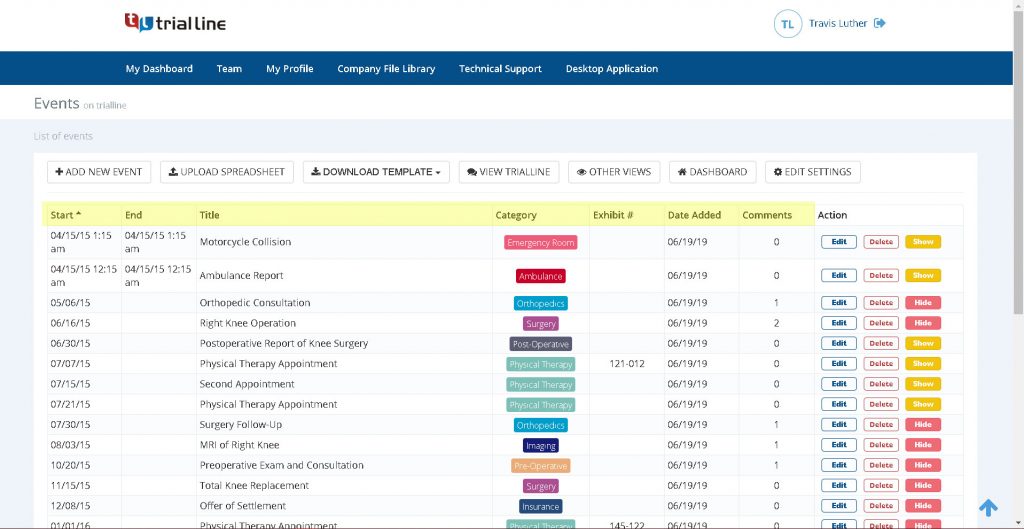
A timeline gives them exactly that: a scaffold to organize everything else.
Cognitive Science 101: Why Timelines Stick
1) Working Memory Is Small–Timelines Reduce Overload
Humans can only hold a limited amount of information in working memory at once. Testimony often arrives as a stream: names, dates, places, claims, contradictions. Jurors must continuously “buffer” that stream while also evaluating credibility.
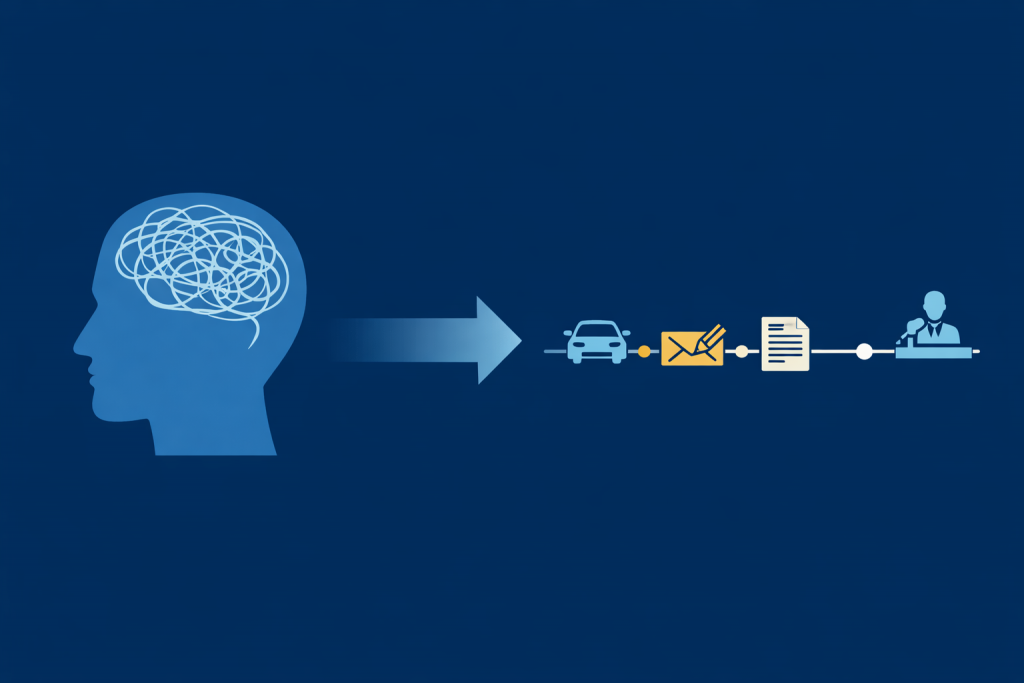
A timeline offloads that burden.
Instead of forcing jurors to keep juggling details mentally, a timeline externalizes the sequence so jurors can focus on meaning:
- What changed?
- What caused what?
- What doesn’t fit?
Bottom line: Timelines reduce cognitive strain and free jurors to reason rather than scramble.
2) The Brain Prefers Organized Stories Over Raw Facts
Jurors don’t remember trials as lists of facts–they remember them as narratives. Cognitive psychology repeatedly shows that humans encode information better when it’s structured into a coherent story with a clear timeline of events.
Testimony can be fragmented:
- Witness A starts mid-incident
- Witness B jumps back two weeks
- An exhibit references a date no one contextualizes
A timeline turns fragments into a continuous story.
Bottom line: Chronology turns “information” into “understanding.”
3) Visual Encoding Improves Recall (Especially Under Stress)
Jurors are listening, watching, and processing in a high-stakes setting. Visuals help because they create an additional “pathway” to memory. When information is both verbal and visual, it’s easier to recall later–particularly during deliberation.
Even simple visual structure (a clean date/event layout) helps jurors:
- recognize patterns
- spot gaps
- remember key transitions
Bottom line: Visual structure makes facts easier to retrieve when it matters most.
4) Timelines Create Anchors That Testimony Often Lacks
Testimony can feel “floaty” to jurors–especially when witnesses speak generally:
- “Around that time…”
- “Sometime in the spring…”
- “I can’t recall the exact day…”
A timeline creates anchors: fixed points that help jurors orient everything else.
Once jurors trust the sequence, they have a framework for judging credibility:
- Does this witness’s account match the sequence?
- Is their timeline plausible?
- What must be true for their story to work?
Bottom line: Anchors turn vague statements into assessable claims.
5) Contradictions Become Obvious When You Put Them in Time
Cross-examination often exposes inconsistencies, but jurors may miss them if they’re buried across multiple days of testimony.
A timeline makes contradictions visible:
- two accounts claim different times
- a document date clashes with a witness claim
- a “reaction” supposedly occurs before the “trigger”
When the sequence is clear, jurors don’t just hear inconsistencies–they see them.
Bottom line: Timelines make conflicts easier to detect and harder to explain away.
Why “Good Testimony” Still Gets Forgotten
Even sincere, articulate witnesses can be hard to remember because testimony is:
- linear and time-bound (jurors can’t replay it)
- delivered once, then replaced by new information
- often not ordered chronologically
- heavy on detail without structure
Jurors may remember impressions (“He seemed credible”) but lose specifics (“Was that before or after the meeting?”). A timeline preserves the specifics.
Turning Cognitive Science Into a Case Strategy
A strong visual timeline isn’t just a graphic. It’s a strategic decision about how jurors will think.
Here are practical ways litigators use timelines effectively:
Use timelines early to frame the narrative
If jurors get your timeline first, they interpret later testimony through your structure.
Keep it clean: clarity beats completeness
A timeline should reduce noise, not add it. Prioritize pivotal events, then layer details when needed.
Tie exhibits and testimony to the timeline
When an exhibit is introduced, jurors should know exactly where it lives in the sequence.
Use timelines to show causation, not just chronology
Chronology answers “what happened when.” Strategy answers “why it matters.”
Why This Matters for trianline.net Users
If your goal is to help jurors retain and use the facts during deliberation, you need more than strong evidence–you need a structure the brain can hold onto.
A timeline:
- lowers cognitive load
- strengthens narrative coherence
- improves recall
- exposes inconsistencies
- supports persuasion without “arguing”
That’s why timelines often outperform testimony in what jurors remember–and why visual case strategy is increasingly central to trial readiness.